
TL;DR:
- AI enhances marketing efficiency through content generation, customer segmentation, and automation.
- Success depends on clear strategy, quality data, human oversight, and targeted implementation.
- AI amplifies human creativity and strategy but cannot replace brand voice and market intuition.
AI is reshaping marketing at a pace that few small business owners anticipated. The promise is real: smarter campaigns, faster content, and more personalized customer experiences. But the gap between what vendors claim and what businesses actually achieve is wide. Harvard research confirms that while AI delivers genuine efficiency gains, full autonomy in marketing remains a distant goal. The businesses winning with AI are not the ones chasing every new tool. They are the ones pairing smart technology with clear strategy and consistent human oversight. This guide cuts through the noise and gives you a practical path forward.
Table of Contents
- What AI in marketing really means for SMBs
- Efficiency gains: What AI tools can and can’t do
- From hype to reality: Common pitfalls and success factors
- Practical steps: Implementing AI in your marketing strategy
- Why real marketing still needs real people
- Explore SimplyAI tools and expertise for smarter marketing
- Frequently asked questions
Key Takeaways
| Point | Details |
|---|---|
| AI amplifies marketing | AI boosts efficiency and customer engagement but relies on human vision for success. |
| Start smart and small | Begin with one channel, audit data, and focus on simple, high-impact automation for early wins. |
| Human oversight is essential | Govern AI with prompts and approval flows to avoid errors and maintain quality. |
| Realistic expectations matter | AI delivers tactical speed and clarity, not instant competitive advantage or strategic direction. |
What AI in marketing really means for SMBs
Before you invest time or budget, it helps to understand what AI in marketing actually does at the operational level. At its core, AI applies machine learning and large language models to analyze data, generate content, and automate repetitive processes. For small and medium-sized businesses, this translates into three primary functions:
- Campaign draft generation: AI tools can produce email copy, ad headlines, and social media posts in seconds, giving your team a strong starting point.
- Customer segmentation: AI analyzes purchase history, browsing behavior, and engagement patterns to group customers by likelihood to convert.
- Response automation: Chatbots and AI agents handle routine inquiries, freeing your team for higher-value conversations.
Optimists project 3 to 4 times productivity gains from AI adoption. The reality, for most SMBs, is more modest but still meaningful: faster execution on repetitive tasks and better use of existing data. As AI amplifies, not replaces your marketing strategy, the leverage comes from removing grunt work, not from replacing human creativity.
“The most effective marketing leaders treat AI as a capable assistant, not an autonomous strategist. Human review of every output is not optional — it is the standard.”
For SMBs exploring AI for SMB growth, the entry point matters enormously. Jumping into five tools at once creates confusion and dilutes results. A smarter move is to identify one channel where you spend the most manual effort and apply AI there first. If that is email marketing, start with AI-assisted subject line testing and segmentation. If it is social media, use AI scheduling and draft generation. The wins compound when you build on a focused foundation.
Common AI marketing myths suggest that AI will autonomously build campaigns that outperform human-led strategies. That is not what the data shows. AI excels at personalizing customer engagement at scale, but the strategic direction, brand voice, and creative vision must come from your team.
Pro Tip: Before implementing any AI tool, audit your existing customer data for completeness and accuracy. Garbage in, garbage out applies here more than anywhere else in marketing.
Efficiency gains: What AI tools can and can’t do
Understanding where AI adds value and where it falls short is the difference between a smart investment and a costly experiment. The table below maps common marketing tasks to the appropriate owner.
| Task | AI handles | Human handles |
|---|---|---|
| Email subject line drafts | Yes | Final approval and brand check |
| Customer segmentation | Yes | Segment strategy and priorities |
| Ad copy variations | Yes | Creative direction and tone |
| Campaign analytics | Yes | Interpretation and decisions |
| Brand storytelling | Partial | Full ownership |
| Crisis communication | No | Full ownership |
AI tools are particularly effective at the following marketing workflows:
- Email campaigns: Automated sequences triggered by user behavior, with personalized content blocks.
- Ad targeting: Predictive models that allocate budget toward the highest-converting audience segments.
- Social scheduling: AI tools analyze engagement patterns and schedule posts at optimal times.
- Performance reporting: Automated dashboards that surface key metrics without manual data pulling.
The efficiency gains from AI are real, but they come with a critical caveat: AI cannot generate a unique brand vision or make judgment calls that require cultural sensitivity and market intuition. These remain firmly human responsibilities.
For practical automation tips for efficiency, the most important principle is to build approval steps into every AI workflow. Do not let AI-generated content go live without a human review. This is not about distrust of the technology. It is about protecting your brand from errors that erode customer confidence.

The AI limitations in marketing are well documented. Without strong data foundations and governance, 74% of businesses struggle to achieve meaningful results. Exploring data-driven automation for SMB efficiency shows that the businesses succeeding with AI are those that treat it as a workflow tool, not a strategy replacement.
Pro Tip: Set a monthly audit cadence for your AI outputs. Review samples of generated content for accuracy, tone, and brand alignment. Catching drift early prevents compounding errors across campaigns.
From hype to reality: Common pitfalls and success factors
The gap between AI marketing hype and actual results is where most SMBs lose money and momentum. Understanding the specific failure patterns helps you avoid them.
| Factor | Success path | Common pitfall |
|---|---|---|
| Data foundation | Clean, structured customer data | Fragmented or incomplete records |
| Governance | Approval flows and prompt controls | Fully automated with no review |
| Budget allocation | Focused on high-ROI channels | Overspending on rising CPCs |
| Brand differentiation | Clear voice and positioning | Generic AI content with no moat |
| Team readiness | Trained and informed staff | Tool adoption without education |
The steps below help SMBs move from hype to measurable results:
- Start small. Choose one marketing channel and one specific task to automate. Prove value before expanding.
- Govern with prompts. Use structured prompts that encode your brand voice, tone, and content rules. This reduces output variability significantly.
- Audit your data. Before any AI tool can perform well, your customer data must be accurate, segmented, and accessible.
- Maintain human review. Every AI output should pass through a human checkpoint before reaching customers.
- Measure and iterate. Define success metrics before launch and review them monthly. Adjust based on what the data tells you.
“AI amplifies strategy. It does not create automatic competitive advantage. The advantage comes from the quality of the strategy you bring to it.”
One of the most overlooked risks is rising cost-per-click (CPC) in paid advertising. As more businesses use AI to optimize ad targeting, competition increases and costs rise. AI marketing governance experts consistently point to foundational marketing principles as the real differentiator. Your brand story, customer relationships, and product quality are assets AI cannot replicate.
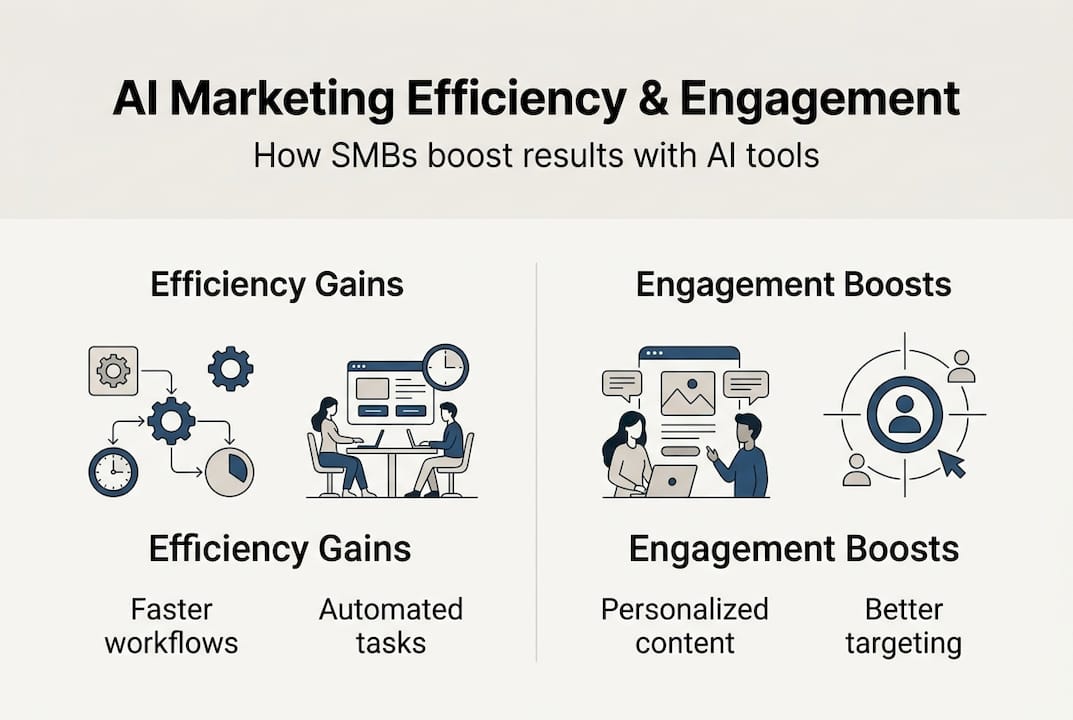
For SMBs building successful business strategies, the lesson is clear: treat AI as a force multiplier for a strategy that already works, not a shortcut to build one from scratch. The AI-first organization roadmap reinforces that governance and leadership alignment are prerequisites, not afterthoughts.
Practical steps: Implementing AI in your marketing strategy
With the pitfalls mapped, the path forward becomes clearer. Here is a step-by-step framework designed specifically for SMBs adopting AI in marketing.
- Define your goals. What specific outcome do you want AI to support? Faster content production, better email open rates, or improved ad targeting? Clarity here drives every decision that follows.
- Audit your data. Review your CRM, email lists, and analytics for completeness. Identify gaps and fix them before connecting any AI tool.
- Choose one channel. Start with one channel and one use case. Email personalization or social content drafting are strong starting points for most SMBs.
- Assign a review process. Name the person responsible for approving AI outputs before they go live. Build this into your workflow, not as an afterthought.
- Measure and iterate. Track the metrics that matter to your goal. Review monthly and adjust your prompts, segments, or tools based on what you learn.
Pro Tip: Use structured prompts that include your brand voice guidelines, target audience description, and content rules. This dramatically improves AI output quality and reduces editing time.
The following AI tools are well suited to SMB marketing workflows:
- AI chatbots: Handle customer inquiries, qualify leads, and deliver personalized responses around the clock.
- Predictive analytics platforms: Identify which customers are most likely to purchase, churn, or respond to specific offers.
- Personalized email automation: Trigger campaigns based on user behavior with dynamically generated content blocks.
For boosting customer engagement through AI, the key is personalization at scale. AI makes it possible to treat each customer as an individual without requiring a dedicated team member for every interaction. But this only works when the underlying data is clean and the strategy is sound.
The AI implementation realities confirm that AI is not a set-it-and-forget-it solution. Your team needs ongoing education about what the tools can and cannot do. Regular training sessions and shared learnings from campaign results keep the entire organization aligned and adaptive.
Why real marketing still needs real people
Here is the view that rarely makes it into vendor presentations: AI is a genuinely powerful tool, and it will not save a weak strategy. The businesses that get the most from AI are not the ones with the most sophisticated tools. They are the ones with the clearest brand identity, the deepest customer understanding, and the strongest internal culture of accountability.
Strategic human leadership is the variable that separates businesses that thrive with AI from those that waste budget on it. Technology does not create competitive advantage on its own. It amplifies whatever foundation you have built. If that foundation is strong, AI accelerates your growth. If it is weak, AI accelerates your problems.
“AI won’t build your brand’s soul — that’s your job.”
The contrarian insight here is this: the businesses most at risk from AI disruption are not those that ignore it. They are those that adopt it without discipline. Chasing every new tool, automating without governance, and expecting AI to replace strategic thinking are the patterns that lead to disappointment. The building an AI-first organization framework makes this point clearly: leadership alignment and cultural readiness come before technology selection.
Pro Tip: Treat AI as a partner in execution, not a replacement for leadership. The best results come when your team uses AI to move faster on the strategy they have already defined, not to avoid defining one.
Explore SimplyAI tools and expertise for smarter marketing
If you are ready to move from theory to action, SimplyAI is built for exactly this moment. We work with small and medium-sized businesses to design and implement AI solutions that deliver real, measurable results without the guesswork.
Our AI automations for business reduce manual workload across marketing, sales, and operations. Our AI agent solutions handle customer engagement around the clock with precision and consistency. And our library of AI prompts for marketing gives your team a governed, structured starting point for every content task. Every solution we build is tailored to your business, your data, and your goals. The next step is simpler than you think.
Frequently asked questions
How should SMBs start using AI in their marketing?
Begin with one marketing channel, audit your data first, and set up AI tools with human approval flows built into every step. Starting focused and governed produces far better results than broad, unmanaged adoption.
Can AI replace my marketing team?
No. AI automates repetitive tasks, but AI amplifies human strategy rather than replacing it. Creative direction, brand judgment, and customer understanding remain firmly in human hands.
What are common risks of adopting AI in marketing?
The primary risks include hype-driven disappointment, rising ad costs, and output errors from poor governance. 74% of businesses struggle to achieve results without a solid strategic foundation in place before adoption.
Which marketing tasks are best automated with AI?
AI excels at grunt work including content drafting, campaign analytics, customer segmentation, and email personalization. These are high-volume, repeatable tasks where speed and scale create immediate value.