
Most business owners assume they already have conversational AI because they installed a chatbot on their website. That assumption is costing them real money. True conversational AI is not a scripted decision tree dressed up with a friendly avatar. It understands natural language, interprets intent, and adapts its responses based on context. The gap between a basic bot and genuine conversational AI is the gap between a vending machine and a knowledgeable sales associate. This guide breaks down what conversational AI actually is, how it works under the hood, and why understanding the difference puts your business in a far stronger position.
Table of Contents
- What is conversational AI? Key concepts explained
- Conversational AI vs. chatbots: What’s the real difference?
- How conversational AI actually works
- Benefits and challenges for small and medium businesses
- What most guides miss about conversational AI for SMBs
- Ready to get started with conversational AI?
- Frequently asked questions
Key Takeaways
| Point | Details |
|---|---|
| Conversational AI vs chatbots | Conversational AI understands intent and context, unlike basic scripted bots. |
| Benefits for SMBs | Small businesses can cut costs and improve customer service quality with AI automation. |
| Common challenges | Issues like context loss and off-topic answers have practical fixes in 2026. |
| Smart adoption strategy | Start with one pain point and focus on systems that adapt and improve over time. |
What is conversational AI? Key concepts explained
Now that we’ve set the stage for understanding, let’s explore what conversational AI truly is and how it differs from the chatbots you’re used to.
Conversational AI technology is a category of software that enables computers to understand, process, and respond to human language in a natural way. It relies on a stack of interconnected technologies: Natural Language Processing (NLP), Machine Learning (ML), Natural Language Understanding (NLU), Natural Language Generation (NLG), and dialog management. Some systems also incorporate Automatic Speech Recognition (ASR) and Text-to-Speech (TTS) for voice interactions.
Think of NLP as the system’s ability to read. NLU is its ability to comprehend what was read. NLG is how it writes a coherent reply. Dialog management keeps track of the conversation’s history and direction. Together, these components allow the system to handle open-ended questions, follow multi-turn conversations, and recover gracefully when a user changes topics mid-sentence.
Traditional chatbots, by contrast, rely on predefined rules and keyword matching. They can answer “What are your business hours?” reliably. Ask them something slightly off-script, and they fail. Conversational AI learns from patterns in data, which means it gets better over time and handles ambiguity far more effectively.
For SMB owners evaluating solutions, the practical implication is significant. A rule-based bot requires you to anticipate every possible question in advance. A conversational AI system handles questions you never expected. If you’re exploring AI agents for businesses or AI-powered support for SMBs, understanding these foundational concepts helps you ask vendors the right questions and avoid paying enterprise prices for glorified FAQ bots.
Pro Tip: When evaluating any AI solution, ask the vendor to demonstrate how their system handles a question it has never seen before. The answer tells you everything about whether you’re looking at real conversational AI or a scripted bot.
Conversational AI vs. chatbots: What’s the real difference?
With a basic definition in place, the next step is to debunk one of the biggest sources of confusion: is all AI the same, or are some solutions just smarter chatbots?
The honest answer is that many products marketed as “AI agents” are, in practice, expensive chatbots. As true conversational AI research highlights, the majority of so-called AI agents lack genuine planning ability, contextual memory, and adaptive reasoning. They trigger pre-written responses based on keyword detection, which is fundamentally the same architecture as a 2010-era chatbot, just with a more polished interface.
Here is a side-by-side comparison to make the distinction concrete:
| Feature | Rule-based chatbot | Conversational AI |
|---|---|---|
| Input handling | Keywords and buttons | Natural language, voice, text |
| Understanding | Pattern matching | Intent and context recognition |
| Adaptability | Static scripts | Learns and improves over time |
| Multi-turn dialog | Limited or none | Tracks full conversation context |
| Common examples | FAQ bots, IVR menus | GPT-based assistants, voice agents |
| Limitations | Breaks on unexpected input | Can hallucinate; needs good data |
This distinction matters for building AI chatbots that actually serve your customers. A rule-based bot might handle 40% of your inbound queries. A well-implemented conversational AI system can handle 70% to 85%, with far higher customer satisfaction scores.
One important nuance: conversational AI augments human support rather than replacing it. Complex complaints, emotionally charged situations, and high-stakes decisions still benefit from a human touch. The goal is to let AI handle volume and speed while your team focuses on cases that genuinely need human judgment.

Pro Tip: Ask any vendor whether their “AI” adapts to real conversation flow or simply triggers pre-set responses. If they can’t answer that clearly, treat it as a red flag.
How conversational AI actually works
Having seen what sets true conversational AI apart, you might ask: how does it actually process a customer’s question behind the scenes?
The process follows a logical sequence, and understanding it helps you make smarter implementation decisions. NLP and ML technologies drive each stage of this pipeline.
- Input capture: The system receives text typed by a user or, in voice applications, audio that is transcribed into text via ASR.
- Natural language understanding: NLU analyzes the input to identify the user’s intent (what they want) and entities (specific details like dates, product names, or locations).
- Context management: The dialog manager checks conversation history to understand whether this message is a new request or a follow-up to something said earlier.
- Response generation: NLG produces a reply that is coherent, contextually appropriate, and aligned with the system’s knowledge base or connected data sources.
- Learning loop: Over time, ML models are updated based on real interactions, improving accuracy and relevance.
The system draws on both structured data (databases, product catalogs, CRM records) and unstructured data (past conversations, support tickets, web content). This is why connecting your conversational AI to your existing business systems matters so much. An AI that can query your inventory in real time delivers dramatically better answers than one operating in isolation. For businesses handling large volumes of documents, AI in document processing can feed structured knowledge directly into the AI’s response pipeline.
Even small configuration choices affect performance. The quality of your training data, the clarity of your system prompts, and how well the AI is connected to live business data all shape whether customers leave a conversation satisfied or frustrated.
Benefits and challenges for small and medium businesses
Understanding the inner workings of conversational AI leads naturally to the biggest question most SMBs have: how does all this technology actually translate into results or risks for your business?
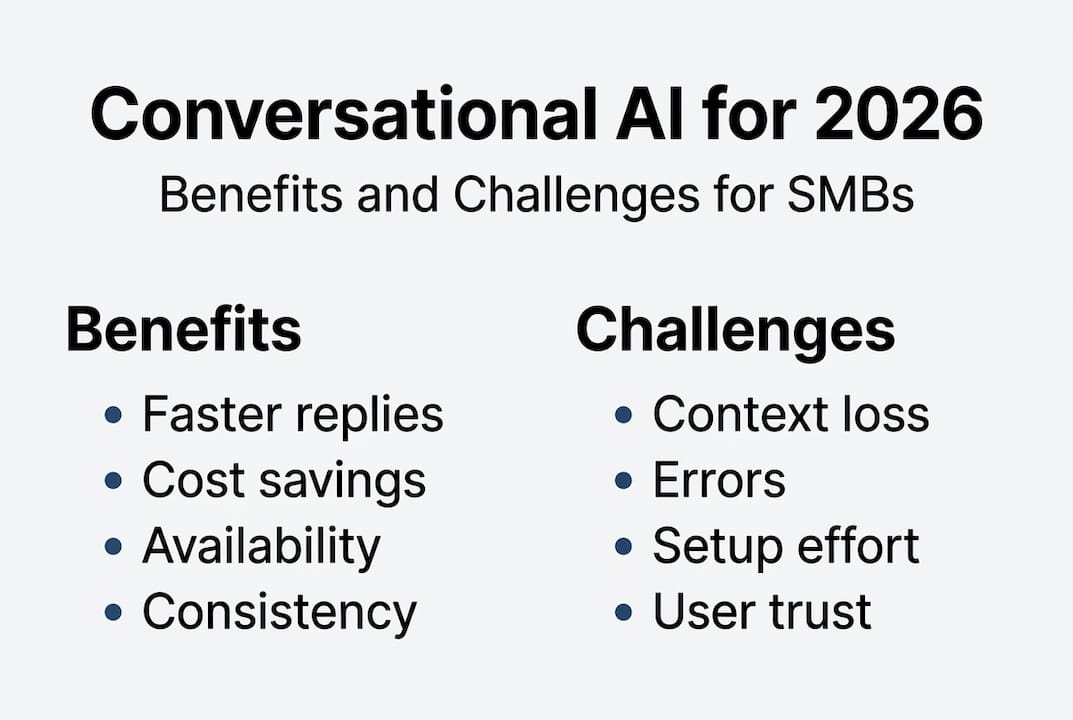
The benefits are real and measurable. Conversational AI enables 24/7 customer support without staffing costs, cuts average response times from hours to seconds, and scales effortlessly during peak periods. For AI for lead generation, conversational AI can qualify prospects, collect contact details, and book appointments autonomously, freeing your sales team for high-value conversations.
Top benefits for SMBs:
- Round-the-clock availability without overtime costs
- Consistent, on-brand responses across every channel
- Faster resolution times and higher customer satisfaction
- Scalability that handles traffic spikes without extra hires
- Rich data capture from every customer interaction
The challenges are equally real, though. Context loss happens when a conversation runs long and the AI forgets what was said earlier. Hallucinations occur when the model generates plausible-sounding but incorrect information. Poor implementation leads to customer frustration, which can damage your brand more than having no AI at all.
The good news is that overcoming AI challenges like hallucinations and context loss is increasingly achievable through Retrieval-Augmented Generation (RAG), structured memory systems, and thread management techniques. RAG, for instance, grounds the AI’s responses in verified documents or databases, dramatically reducing fabricated answers. Exploring alternative AI tools can also help you find platforms that have already solved these problems at the infrastructure level.
The key takeaway is balance. Conversational AI handles volume, speed, and consistency exceptionally well. Humans handle empathy, nuance, and escalations. Build your system with that division of labor in mind, and you’ll see strong results.
What most guides miss about conversational AI for SMBs
After exploring the landscape of benefits and challenges, it’s time for some straight talk: what really matters when SMBs approach conversational AI?
Most guides focus on features. They compare large language models, benchmark response speeds, and rank platforms by integration count. What they rarely discuss is the unsexy truth: the quality of your planning and ongoing maintenance matters far more than which AI model you choose.
We’ve seen businesses invest in sophisticated platforms only to deploy them with vague intents, no connection to live data, and zero process for reviewing failed conversations. The result is an expensive system that performs worse than a well-configured basic bot. Conversely, businesses that start with one clear pain point, map the conversation flow carefully, and commit to weekly review cycles see dramatic results within weeks.
Investing in structured memory and context management delivers more ROI than chasing the newest model release. A system that remembers what a customer said three messages ago, and connects that to their order history, feels genuinely intelligent. That feeling builds trust and drives retention.
For SMBs exploring adaptive AI for automation, the principle is the same: adaptability comes from good architecture, not just powerful models.
Pro Tip: Avoid overcomplicating your first rollout. Pick one high-volume, low-complexity use case, such as appointment booking or order status inquiries, and build from there.
Ready to get started with conversational AI?
If you’re ready to make conversational AI part of your business toolkit, here’s where to take the next step.
SimplyAI designs and implements conversational AI solutions built specifically for small and medium-sized businesses. Whether you need to automate customer support, qualify leads around the clock, or integrate AI into your existing workflows, we build systems that deliver measurable results from day one.
Explore our AI automation services to see how we streamline operations, or learn more about our conversational AI agents designed to handle real customer interactions autonomously. You can also browse our AI prompts gallery for practical starting points. The right implementation starts with a clear plan, and we’re here to help you build one.
Frequently asked questions
How does conversational AI differ from regular chatbots?
Conversational AI understands language, intent, and context dynamically, while regular chatbots rely on scripted responses and keyword triggers that break down when users go off-script.
Can conversational AI completely replace my support staff?
No. AI augments human agents by handling routine, high-volume interactions, but human staff remain essential for emotionally complex and high-stakes situations.
What are the most common challenges with conversational AI?
Context loss, hallucinations, and user frustration are the most frequent issues, but RAG and structured memory techniques available in 2026 resolve most of these at the infrastructure level.
Is conversational AI expensive to implement?
Costs vary widely depending on the platform and scope, but cloud-based solutions and SMB-focused providers have made entry-level implementations significantly more affordable compared to even two or three years ago.