
Businesses are pouring resources into AI, yet many struggle to see meaningful returns. The gap between AI potential and actual results stems from unclear strategies, misaligned expectations, and poor implementation. Small to medium business owners need practical, actionable guidance to integrate AI tools that genuinely boost efficiency and customer experience. This guide walks you through preparing, implementing, and measuring AI solutions in 2026, helping you avoid common pitfalls and capture real value from your investment.
Table of Contents
- Preparing Your Business For AI Integration
- Step-By-Step Guide To Implementing AI In Your Business
- Measuring AI Impact And Ensuring Ongoing Success
- Unlock AI Superpowers For Your Business
- FAQ
Key takeaways
| Point | Details |
|---|---|
| Focus beats complexity | High failure rates with AI investments highlight the need for focused, customized approaches rather than broad deployments. |
| Start small, scale smart | Beginning with simple AI tools reduces costs and speeds adoption while proving value before major commitments. |
| Partners accelerate success | External partnerships double success rates compared to internal builds, bringing expertise and proven frameworks. |
| Culture drives outcomes | AI boosts innovation and efficiency but requires workflow reorganization and leadership commitment to realize benefits. |
| Metrics matter most | Tracking ROI and learning continuously are vital to capturing true AI benefits and justifying ongoing investment. |
Preparing your business for AI integration
Successful AI adoption starts long before you select tools or vendors. The foundation lies in leadership vision and organizational readiness. Learning, not infrastructure or talent, creates the core barrier to scaling AI effectively. Your leadership team must understand AI capabilities, limitations, and the commitment required to capture value.
Start by defining clear business outcomes. What specific problems will AI solve? Are you reducing customer service response times, automating repetitive data entry, or improving inventory forecasting? Vague goals like “become more innovative” or “use AI” guarantee wasted resources. Instead, identify measurable targets: cut email response time by 40%, reduce manual invoice processing by 60%, or increase lead qualification accuracy by 30%.
Vision and commitment at leadership levels determine whether AI initiatives thrive or stall. Executives must champion the effort, allocate budget, and communicate why AI matters to the organization. Without this backing, teams lack resources and motivation to push through inevitable implementation challenges.
Understand that AI will reshape workflows and skill requirements. Your customer service team might shift from answering routine questions to handling complex escalations. Your marketing staff could move from creating basic content to refining AI outputs and strategy. Plan for training, role adjustments, and potential resistance. Building an AI-first organization requires cultural shifts alongside technological ones.
Adopt an incremental approach to manage risk and cost. Rather than betting your budget on a comprehensive AI overhaul, test one application in a single department. Learn from that pilot before expanding. This strategy reduces financial exposure while building organizational confidence and expertise.
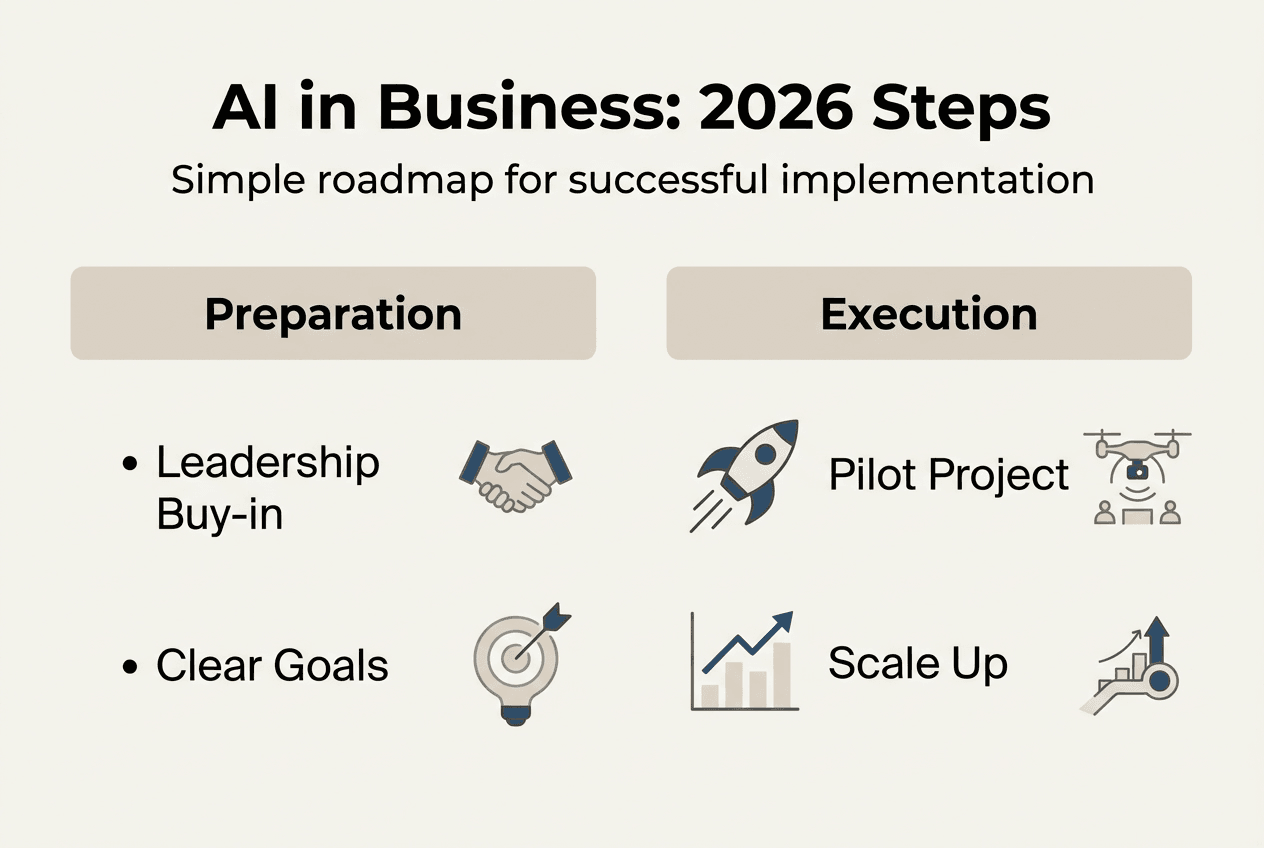
Set realistic ROI timelines. AI rarely delivers overnight transformation. Early gains might be modest, improving efficiency by 10-20% in targeted areas. Compounding benefits emerge as you refine implementations, expand applications, and develop internal expertise. Expect 6-12 months before significant returns materialize.
Pro Tip: Create a simple one-page AI readiness assessment covering leadership support, budget availability, data quality, team skills, and workflow flexibility. Score each area honestly to identify gaps before launching initiatives.
Step-by-step guide to implementing AI in your business
Once your organization is prepared, follow this structured approach to implement AI solutions that deliver measurable value.
Choose your starting point
Identify the simplest, highest-impact application for your first AI project. Look for tasks that are repetitive, time-consuming, and rule-based. Common starting points include:
- Customer service chatbots handling frequently asked questions
- Email sorting and response drafting for sales or support teams
- Invoice processing and data entry automation
- Social media content scheduling and basic copywriting
- Lead scoring and qualification in your CRM
Start with low-cost, accessible tools rather than custom development. Many AI platforms offer free trials or affordable monthly subscriptions. This reduces financial risk while you validate the technology’s fit for your business.
Run a focused pilot
Select one team or department to test your chosen AI application. Define success metrics upfront: response time reduction, hours saved per week, accuracy improvement, or customer satisfaction scores. Set a pilot duration of 4-8 weeks, long enough to gather meaningful data but short enough to maintain momentum.

Document baseline performance before launching the pilot. If you’re testing a customer service chatbot, track current response times, resolution rates, and team workload. These benchmarks let you measure actual impact rather than relying on impressions.
Train your pilot team thoroughly. They need to understand what the AI can and cannot do, how to handle edge cases, and when to escalate issues. Their feedback will be invaluable for refining the implementation.
Pro Tip: Assign one person as the AI champion for your pilot, someone who owns the project, troubleshoots issues, and collects team feedback. This focused ownership dramatically increases pilot success rates.
Partner with AI experts
Nearly 9 in 10 companies use AI in at least one function, and success rates climb with external partnerships. Building AI solutions internally demands specialized skills, significant time investment, and trial-and-error learning. External partnerships have twice the success rate of internal builds, bringing proven frameworks and technical expertise.
Look for partners who understand your industry and business size. Large enterprise solutions rarely fit small to medium businesses well. You need vendors who can customize tools to your workflows, provide hands-on support, and scale as you grow. Services like AI automations offer tailored implementations designed for practical business outcomes.
Evaluate potential partners on implementation speed, support quality, and pricing transparency. Avoid vendors who push complex, expensive solutions for simple problems. The right partner simplifies AI adoption rather than complicating it.
Scale what works
After your pilot demonstrates value, expand the successful application to additional teams or locations. Use the lessons learned to streamline onboarding and address common challenges proactively. Scaling proven solutions is far less risky than launching multiple untested initiatives simultaneously.
Once your first AI application runs smoothly, identify your next opportunity. Apply the same pilot approach: start small, measure carefully, and scale based on results. This iterative method builds organizational capability while managing risk.
Track key performance indicators throughout implementation. Monitor not just efficiency metrics but also user adoption, error rates, and customer feedback. AI tools that teams resist or customers dislike won’t deliver value regardless of their technical capabilities. Stay current with AI automation trends to identify new opportunities as the technology evolves.
| Implementation Phase | Timeline | Key Activities | Success Indicators |
|---|---|---|---|
| Preparation | 2-4 weeks | Define goals, secure leadership buy-in, select pilot area | Clear metrics, allocated budget, team commitment |
| Pilot Launch | 4-8 weeks | Deploy AI tool, train users, collect feedback | Baseline vs. current performance, user adoption rate |
| Evaluation | 1-2 weeks | Analyze results, document lessons, decide on scaling | Measurable improvement, positive ROI, team satisfaction |
| Scaling | 8-12 weeks | Expand to additional teams, refine processes, optimize | Consistent performance across teams, growing efficiency gains |
Measuring AI impact and ensuring ongoing success
Implementing AI is just the beginning. Sustained value requires rigorous measurement, continuous improvement, and adaptation as your business and the technology evolve.
Establish benchmarks before deploying any AI solution. Document current performance across relevant metrics: processing time, error rates, customer satisfaction, employee hours spent, or revenue per customer. These baselines let you calculate actual ROI rather than guessing at impact.
Regularly measure key metrics to identify improvement areas. Review performance weekly during initial implementation, then monthly once the system stabilizes. Look beyond efficiency gains to quality indicators. Is your AI chatbot resolving issues correctly, or just responding quickly with unhelpful answers? Are automated emails generating engagement, or getting ignored?
Companies can measure performance and identify levers to accelerate AI value creation through disciplined tracking. Create a simple dashboard showing your most important metrics. Share it with stakeholders to maintain visibility and accountability.
Understand that modest efficiency gains are common initially, but transformative outcomes require discipline and focus. Early results might show 15% time savings or 20% cost reduction. As you refine implementations, train teams, and optimize workflows, these improvements compound. A 15% initial gain can grow to 40-50% over 12-18 months with continuous optimization.
Avoid common pitfalls that undermine AI success:
- Overestimating immediate cost savings while underestimating implementation effort
- Ignoring workflow impacts and change management needs
- Deploying AI without adequate training or support resources
- Failing to maintain and update AI systems as business needs evolve
- Measuring only efficiency while neglecting quality and user satisfaction
Build a culture of continuous learning around AI. Encourage teams to experiment, share discoveries, and suggest improvements. The SimplyAI blog offers ongoing insights into AI best practices and emerging capabilities. Consider how centralized AI intelligence can coordinate multiple AI tools for greater impact.
Schedule quarterly AI reviews with leadership and implementation teams. Assess what’s working, what’s not, and where new opportunities exist. Technology and business needs both change rapidly. Regular reviews ensure your AI strategy stays aligned with organizational priorities.
Pro Tip: Create a simple ROI calculator that tracks both hard savings (reduced labor hours, lower processing costs) and soft benefits (improved customer satisfaction, faster response times). This comprehensive view helps justify continued AI investment and guides expansion decisions.
| Metric Category | What to Measure | Why It Matters |
|---|---|---|
| Efficiency | Time saved, tasks automated, processing speed | Quantifies productivity gains and labor cost reduction |
| Quality | Error rates, accuracy, customer satisfaction | Ensures AI improves outcomes, not just speed |
| Adoption | User engagement, feature utilization, resistance | Indicates whether teams embrace or avoid the AI tools |
| Financial | Cost savings, revenue impact, ROI percentage | Justifies investment and guides budget allocation |
Unlock AI superpowers for your business
You’ve learned the framework for successful AI implementation, but executing it effectively requires expertise, time, and technical capabilities many small to medium businesses lack. That’s where specialized partners make the difference.
SimplyAI designs and implements AI automations tailored to your specific business challenges. We handle the technical complexity while you focus on running your business. Our AI agents provide advanced customer support, lead qualification, and process automation that adapts to your workflows.
We’ve helped dozens of small and medium businesses achieve measurable results: 60% reductions in customer service response times, 40% increases in lead conversion rates, and significant decreases in manual administrative work. Our approach follows the proven framework outlined in this guide, starting with focused pilots and scaling based on demonstrated value.
Partner with experts who understand your constraints and goals. Visit SimplyAI to explore how customized AI solutions can transform your business operations, improve customer experience, and free your team to focus on high-value activities. Let’s turn AI potential into practical results for your business.
FAQ
What are simple AI tools suitable for small businesses?
Start with AI-powered chatbots for customer service, email automation tools for marketing and sales, or AI writing assistants for content creation. These applications require minimal technical expertise, offer affordable pricing, and deliver quick wins that build confidence. Many platforms provide templates and pre-built workflows designed specifically for small business needs.
How long does it typically take to see benefits from AI?
Expect 4-8 weeks to see initial results from simple AI applications like chatbots or email automation. More complex implementations involving workflow redesign or custom integrations may require 3-6 months before significant benefits materialize. The key is starting with focused pilots that can demonstrate value quickly, then scaling proven solutions.
Is hiring external AI experts necessary?
External partnerships double success rates compared to internal builds, making them highly valuable for most small to medium businesses. You gain proven expertise, faster implementation, and ongoing support without building specialized internal teams. However, very simple AI tools with strong vendor support can be implemented internally if you have technically capable staff.
What mistakes should small businesses avoid when adopting AI?
Avoid trying to implement AI everywhere at once, which spreads resources thin and reduces focus. Don’t skip the pilot phase or fail to measure baseline performance before deployment. Resist choosing complex, expensive solutions when simpler tools would work. Never underestimate the importance of training and change management for successful adoption.
How can I measure AI ROI effectively?
Track both quantitative metrics (time saved, costs reduced, revenue increased) and qualitative benefits (customer satisfaction, employee morale, competitive advantage). Establish clear baselines before implementation, then measure consistently using the same methodology. Calculate ROI by comparing total benefits against implementation and ongoing costs, including software, training, and support expenses over a 12-month period.