TL;DR:
- Most ecommerce funnel leaks occur at multiple stages, but AI can significantly improve conversion rates.
- Proper data preparation and phased AI implementation are crucial for sustainable growth and ROI.
- AI tools like personalization, automation, and predictive scoring help recover carts and optimize the checkout process.
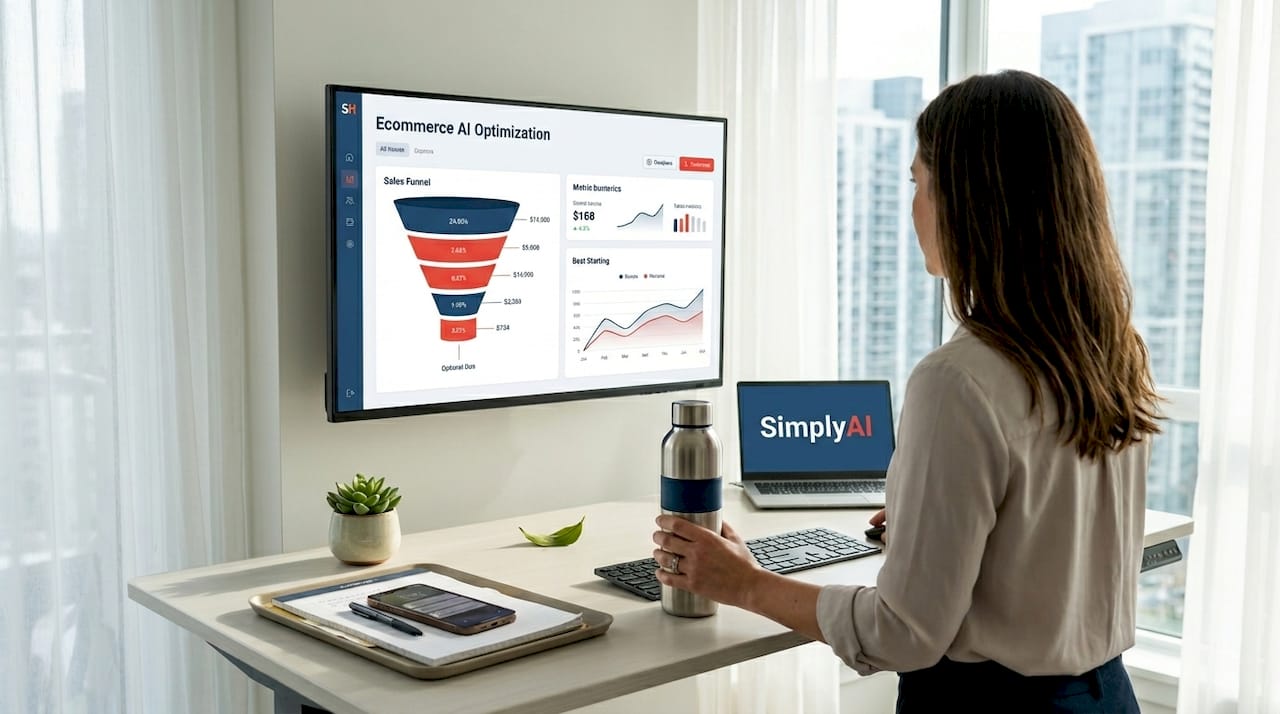
Most ecommerce businesses lose roughly 70% of shoppers before they ever reach checkout. That is not a minor leak; it is a structural problem that compounds with every dollar you spend on traffic. The good news is that AI has moved well beyond hype and is now delivering double-digit conversion lifts for businesses that apply it strategically. This guide walks you through understanding where your funnel breaks, preparing the right data foundation, implementing AI at every stage, and verifying that your results are real and sustainable. If you manage an ecommerce operation and want measurable growth without hiring an army of analysts, this is the playbook you need.
Table of Contents
- Understanding the ecommerce funnel and AI’s role
- Preparing your data and choosing high-ROI AI tools
- Step-by-step: Implementing AI at each funnel stage
- Recovering abandoned carts and optimizing checkout
- Measuring, testing, and scaling your AI funnel optimization
- Perspective: The real keys to sustainable AI-driven funnel growth
- Explore done-for-you AI ecommerce automation solutions
- Frequently asked questions
Key Takeaways
| Point | Details |
|---|---|
| AI lifts funnel conversion | AI personalization and automation boost conversion rates and revenue, especially for SMBs. |
| Start with data foundation | Strong data quality is essential before layering AI tools onto your ecommerce funnel. |
| Phased rollout wins | Implement quick-win AI features like recommendations and cart recovery first before scaling to advanced applications. |
| Continuous monitoring | Track impact, test improvements, and keep human oversight for best results with AI-optimized funnels. |
Understanding the ecommerce funnel and AI’s role
The ecommerce funnel moves shoppers through five distinct stages: awareness (discovering your brand), consideration (evaluating products), cart (adding items), checkout (completing the purchase), and loyalty (returning to buy again). Each stage has its own conversion dynamics, and each one leaks value in different ways. Awareness campaigns may drive unqualified traffic. Product pages may fail to communicate value. Checkout friction sends ready buyers elsewhere.
The numbers tell a stark story. Global ecommerce conversion rates sit between 2.5% and 3.3%, with cart abandonment hovering near 70% and add-to-cart rates between 6% and 7%. AI-driven optimizations have been shown to lift these metrics by 6% to 19% in documented cases, which is a meaningful shift for any SMB operating on thin margins.
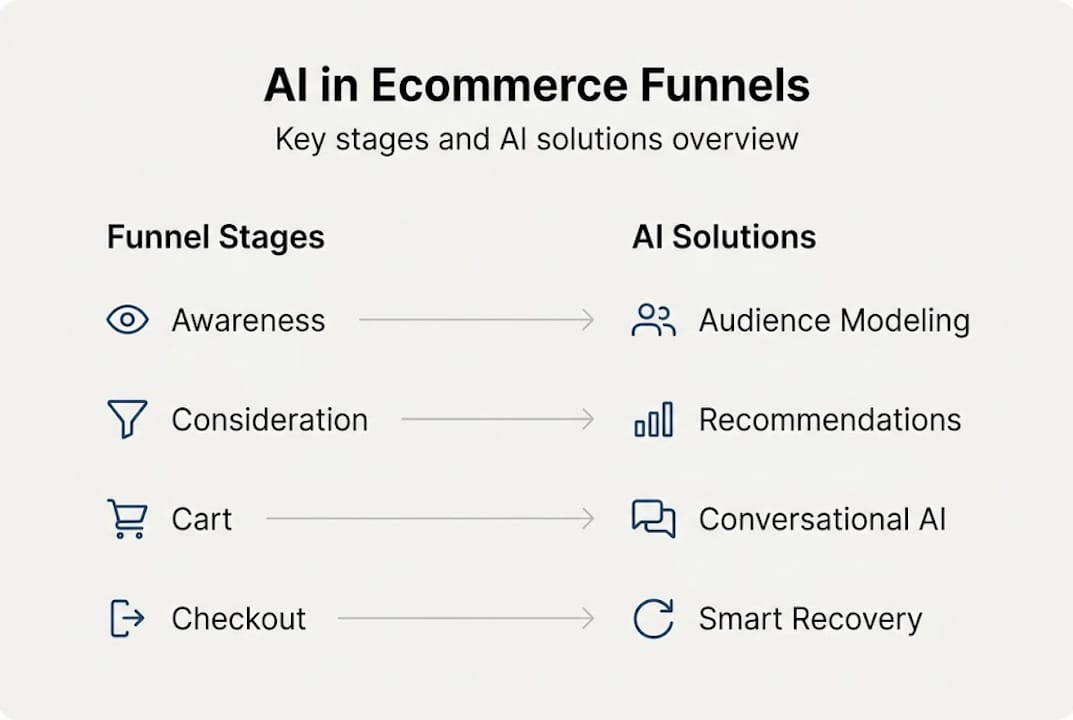
AI enhances each funnel stage through four core capabilities: personalization (showing the right product to the right person), automation (triggering timely messages without manual effort), prediction (anticipating intent before the shopper acts), and recovery (re-engaging lost sessions). Exploring personalization tactics in ecommerce reveals how much untapped revenue sits in your existing traffic.
Here is where most funnel losses occur and what AI can address:
- Awareness stage: Generic ad targeting wastes budget on low-intent audiences. AI-driven audience modeling improves match quality.
- Consideration stage: Static product pages ignore individual preferences. AI-powered personalization strategies adapt content dynamically.
- Cart stage: Shoppers add items and disappear. Predictive intent scoring flags at-risk sessions in real time.
- Checkout stage: Unexpected costs and friction cause last-second exits. AI can streamline the process and surface relevant incentives.
- Loyalty stage: Post-purchase communication is often generic. AI segments customers by behavior and automates relevant follow-ups.
| Funnel stage | Common leak | AI solution |
|---|---|---|
| Awareness | Low-quality traffic | Predictive audience modeling |
| Consideration | Poor product discovery | Recommendation engines |
| Cart | Abandonment | Intent scoring and exit intercepts |
| Checkout | Friction and surprise costs | Dynamic incentives and UX optimization |
| Loyalty | Churn | Behavioral segmentation and automation |
Preparing your data and choosing high-ROI AI tools
Once you know where AI fits, the next step is laying the groundwork to ensure success. AI is only as good as the data you feed it. Garbage in, garbage out is not a cliche here; it is a financial reality. Before deploying any AI tool, you need clean, structured, and accessible data from your storefront, CRM, and analytics platform.
Prioritizing first-party data before AI deployment is critical. Zero-party data, meaning information customers voluntarily share through quizzes or preference centers, is even more valuable because it carries explicit intent. Starting with high-ROI tactics like product recommendations and cart recovery gives SMBs the fastest path to measurable results without overextending their tech stack.
For SMBs, the right sequencing of AI tools matters as much as the tools themselves. Reviewing an AI adoption checklist before committing to a platform helps avoid costly mismatches between your data maturity and the tool’s requirements.
Here is a comparison of AI tools by funnel stage and typical SMB suitability:
| AI tool type | Funnel stage | SMB suitability | Typical setup time |
|---|---|---|---|
| Recommendation engine | Consideration, cart | High | 1 to 2 weeks |
| Cart recovery automation | Cart, checkout | High | 3 to 5 days |
| Predictive intent scoring | Cart | Medium | 2 to 4 weeks |
| Dynamic content personalization | All stages | Medium | 2 to 3 weeks |
| Agentic AI shopping assistant | All stages | Growing | 4 to 8 weeks |
Your data preparation checklist should cover these essentials:
- Confirm that product catalog data is complete and consistently structured.
- Verify that customer purchase history is accessible and tagged by segment.
- Ensure your analytics platform (GA4 or equivalent) is firing events correctly.
- Audit your email and CRM data for duplicates and outdated contacts.
- Map your existing tech stack to identify integration points for new AI tools.
Pro Tip: Start with a single high-impact use case, such as a recommendation engine on your product pages. Prove the ROI, then layer in additional AI capabilities. Exploring business strategies for AI adoption can help you sequence your roadmap effectively.
Step-by-step: Implementing AI at each funnel stage
With the prep done, you are ready to put AI to work at every stage. The implementation process is most effective when you move stage by stage rather than trying to automate everything at once.

Awareness: Deploy AI-powered audience modeling within your ad platforms to identify high-intent lookalike segments. Feed these models with your best customer data, not just email lists, but behavioral profiles from your CRM.
Consideration: Activate a product recommendation engine on category pages and product detail pages. AI-driven personalization through dynamic content and homepage adaptation boosts conversion rates by 15% to 40% across funnel stages. Pair this with dynamic content blocks that adapt to browsing history.
Cart: Introduce a conversational AI assistant that answers product questions and addresses objections in real time. Conversational AI for ecommerce reduces friction at the moment shoppers are most likely to abandon. Enable predictive intent scoring to flag sessions showing exit signals.
Checkout: Automate dynamic incentive delivery, offering free shipping or a small discount only to sessions with high abandonment probability. Avoid blanket discounting, which trains customers to wait for deals.
Here is the numbered implementation sequence:
- Integrate your recommendation engine with your product catalog and behavioral data.
- Configure intent scoring thresholds based on your historical abandonment patterns.
- Deploy a chatbot assistant on high-traffic product and cart pages.
- Set up automated exit-intent triggers with personalized messaging.
- Activate post-checkout loyalty sequences using behavioral segmentation.
Agentic AI agents and autonomous shopping assistants enable 4x higher conversion rates compared to static experiences. These agents handle the full shopper journey from recommendation to checkout without requiring manual intervention at each step. Reviewing agentic AI for conversion and personalization best practices gives you a practical framework for deploying these systems responsibly.
AI needs ongoing human oversight. Automated systems can develop blind spots, amplify biases in your data, or optimize for the wrong metric. Schedule weekly reviews of AI-driven outputs during the first 90 days.
Pro Tip: The biggest implementation trap is configuring AI once and walking away. Treat your AI funnel like a live campaign, not a set-and-forget installation.
Recovering abandoned carts and optimizing checkout
Even with the best funnel, carts will be abandoned. The question is how many you can rescue. Cart abandonment is driven by a predictable set of causes: unexpected shipping costs, forced account creation, slow page load times, limited payment options, and general decision fatigue. AI addresses each of these with precision that manual campaigns simply cannot match.
AI-powered cart recovery using predictive intent scoring, real-time exit-intent triggers, and personalized recovery sequences recovers between 15% and 56% of lost carts. That range reflects the difference between basic email follow-ups and fully optimized, multi-channel AI recovery systems.
The must-do actions for optimal checkout recovery include:
- Intent scoring: Score every session in real time based on scroll depth, time on page, and cursor movement toward the browser close button.
- Exit-intent intercepts: Trigger a personalized overlay when a high-risk session is detected, offering a relevant incentive rather than a generic discount.
- Personalized recovery emails: Send sequenced emails that reference the specific products left behind, not generic cart reminder messages.
- SMS recovery: For opted-in customers, a timely SMS with a direct cart link outperforms email by a significant margin.
- Dynamic incentives: Vary the offer based on customer lifetime value. A high-value repeat customer deserves a better incentive than a first-time visitor.
Reviewing the AI abandoned cart playbook reveals how data-driven cart recovery strategies outperform intuition-based campaigns consistently. The critical discipline here is avoiding over-discounting. If every abandoned cart triggers a 15% discount, you are training your best customers to abandon intentionally.
Measuring, testing, and scaling your AI funnel optimization
Once your AI funnel is live, measurement and continuous improvement are essential for sustainable growth. The KPIs that matter most are conversion rate lift, revenue per visitor, cart recovery rate, and customer lifetime value. Tracking these over 30, 60, and 90-day windows gives you a clear picture of whether your AI investments are compounding or plateauing.
Full-funnel optimization requires unified analytics using GA4 or a customer data platform (CDP) to identify bottlenecks. AI excels at real-time adaptation, but it still needs human oversight to catch drift and misalignment with business goals. Exploring a full funnel analytics framework helps you structure your measurement approach before results start rolling in.
AI-powered testing differs from traditional A/B testing in one important way: it can run multivariate experiments across hundreds of variables simultaneously and adapt in real time, rather than waiting for statistical significance over weeks. The tradeoff is interpretability. You may see results without always knowing exactly why they worked.
Here is a typical results table for AI-driven SMB funnels:
| Metric | Baseline | AI-optimized target | Timeline |
|---|---|---|---|
| Conversion rate | 2.5% to 3.3% | 3.5% to 4.5% | 60 to 90 days |
| Cart recovery rate | 5% to 10% | 15% to 30% | 30 to 60 days |
| Revenue per visitor | Varies | 10% to 20% lift | 60 to 90 days |
| Email open rate (recovery) | 15% to 20% | 30% to 45% | 30 days |
The scaling sequence:
- Validate quick wins (recommendations, cart recovery) within the first 30 days.
- Expand to dynamic content personalization across all major pages.
- Introduce agentic AI assistants once behavioral data is sufficient for training.
- Integrate CDP-level analytics to unify cross-channel data.
- Automate loyalty and post-purchase sequences based on behavioral segments.
Pro Tip: When boosting marketing efficiency with AI, resist the urge to scale every tactic at once. Consolidate your wins, then expand. Spreading AI investment too thin produces mediocre results across the board.
Perspective: The real keys to sustainable AI-driven funnel growth
Most guides on AI funnel optimization focus on tools. The harder truth is that tools are rarely the bottleneck. The businesses that see lasting results from AI are the ones that invest in their data foundation first and treat AI as an ongoing discipline rather than a one-time deployment.
Jumping straight to advanced AI, agentic assistants, predictive modeling, and real-time personalization, without clean data and clear KPIs, is one of the most common and costly mistakes SMBs make. The technology will optimize aggressively for whatever signal you give it. If your data is flawed, AI will optimize toward the wrong outcome with remarkable efficiency.
Phased roadmaps work because they build organizational confidence alongside technical capability. Start with high-impact, manageable steps. Prove the value internally. Then scale. Reviewing phased AI growth strategies reinforces why this sequencing is not just practical, it is strategic.
Human oversight will always matter more than the sophistication of the tool. AI can identify patterns no analyst could find manually, but it cannot tell you whether those patterns align with your brand values or long-term customer relationships. That judgment belongs to your team.
Explore done-for-you AI ecommerce automation solutions
Ready to streamline and supercharge your funnel with expert help? Implementing AI across your ecommerce funnel is powerful, but it requires the right architecture, clean data pipelines, and ongoing optimization. That is exactly where SimplyAI comes in.
SimplyAI designs and implements AI ecommerce automations and AI agents for sales funnels tailored specifically for small and medium-sized businesses. From product recommendation engines to agentic shopping assistants and automated cart recovery sequences, we build the systems that turn your funnel from a leaky bucket into a revenue engine. If you are ready to move from strategy to execution, explore our services and see what a done-for-you AI implementation looks like in practice.
Frequently asked questions
What are the most effective AI tools for ecommerce funnel optimization?
The most effective tools include personalized recommendation engines, agentic AI chatbots, predictive cart recovery systems, and continuous testing platforms. AI-driven personalization and recovery engines consistently deliver the highest conversion lifts across funnel stages.
How quickly can SMBs see ROI from implementing AI in their funnel?
Many SMBs see measurable results from recommendations and cart recovery within 30 days, with quick wins from AI tactics starting at 6% conversion lifts and growing with continued optimization.
What is agentic AI and how does it impact conversion rates?
Agentic AI refers to autonomous assistants that guide shoppers from discovery through checkout without manual intervention. These systems enable 4x higher conversion rates compared to static ecommerce experiences.
How does AI prevent off-putting or intrusive personalization?
AI uses intent scoring, frequency capping, and dynamic incentives to keep personalization relevant and non-intrusive. Avoiding over-discounting and using intent scoring ensures the experience feels helpful rather than surveillance-driven.
What are common pitfalls when using AI for ecommerce optimization?
The most frequent mistakes include poor first-party data quality, siloed data systems, over-reliance on blanket discounts, and failing to monitor AI outputs. Avoiding data silos and poor mobile UX is foundational to any successful AI funnel strategy.