Many business leaders think AI agents are just fancy chatbots. They’re not. AI agents operate autonomously, executing complex multi-step workflows without constant human input. Unlike chatbots that respond to single queries, AI agents perceive their environment, reason through problems, plan actions, and learn from outcomes. For small and medium businesses exploring ways to boost efficiency and enhance customer interactions, understanding AI agents is crucial. This guide clarifies what AI agents really are, compares different types, shows proven ROI data, addresses risks, and provides practical steps to start implementing them safely in your operations.
Table of Contents
- Understanding AI Agents: Core Components And Workflows
- Types Of AI Agents And Their Business Applications
- Benefits And ROI Of AI Agents For Small And Medium Businesses
- Managing Risks And Best Practices For AI Agent Deployment
- Enhance Your Business With SimplyAI’s AI Agent Solutions
- What Is An AI Agent? Frequently Asked Questions
Key takeaways
| Point | Details |
|---|---|
| Autonomous workflows | AI agents execute complex multi-step tasks through iterative perception, reasoning, planning, and action cycles without constant supervision. |
| Proven ROI for SMBs | Businesses report 85-95% time savings on repetitive tasks with payback periods of 3-6 months and 93% experiencing revenue growth. |
| Multiple agent types | Options range from simple rule-based systems to sophisticated multi-agent networks, each suited for different operational needs. |
| Risk mitigation matters | Hallucinations and error cascades require hybrid human-AI control, graduated autonomy, and robust monitoring protocols. |
| Start strategically | Begin with human-activated agents for customer interactions and text-heavy tasks, scaling autonomy as you gain experience. |
Understanding AI agents: core components and workflows
AI agents are autonomous software systems that perceive, reason, plan, act, and learn with minimal human intervention. This autonomy sets them apart from traditional software that waits for explicit commands. Think of an AI agent as a digital employee that can handle entire workflows, not just isolated tasks.
The magic happens through a continuous loop. AI agents operate via iterative perceive-reason-plan-act-reflect cycles enabling multi-step autonomy, unlike reactive chatbots. When a customer emails your support team, a chatbot might suggest a help article. An AI agent reads the email, checks your inventory system, verifies the customer’s order history, identifies the root issue, drafts a personalized solution, and schedules a follow-up if needed. All without human input.
Chatbots handle single-turn interactions. You ask, they respond, conversation ends. AI agents tackle multi-step problems that require context retention, decision-making across multiple systems, and adaptive responses based on changing conditions. A chatbot tells you business hours. An AI agent reschedules appointments, notifies affected parties, updates your calendar, and adjusts staff schedules accordingly.
Every AI agent contains five core components working together:
- Perception gathers data from emails, databases, sensors, or APIs to understand the current situation
- Reasoning uses large language models as the decision-making brain to interpret information and determine appropriate responses
- Planning employs techniques like Chain of Thought to break complex goals into executable steps
- Action connects to tools and APIs to execute decisions in your business systems
- Memory maintains short-term context for ongoing tasks and long-term knowledge from past interactions
“The real power of AI agents lies in their ability to handle ambiguity and make contextual decisions across multiple business systems, something traditional automation could never achieve.”
Consider a real SMB scenario. Your customer service team receives 200 emails daily. An AI agent perceives each message, reasons about the issue type, plans the resolution steps, acts by pulling data from your CRM and inventory systems, drafts responses, and learns which solutions work best. What took your team 6 hours now happens in 20 minutes. The rise of digital workers explores how this transformation is reshaping business operations.

Types of AI agents and their business applications
Understanding which AI agent type fits your needs prevents costly mismatches between technology and business requirements. Each type offers different levels of sophistication, cost, and capability.
Simple reflex agents follow predefined rules. If customer asks about pricing, show price list. They’re fast and predictable but can’t handle unexpected situations. Model-based agents maintain an internal representation of their environment, tracking changes over time. They remember that a customer called yesterday about a delayed shipment and reference that context today.
Goal-based agents work toward specific objectives. Tell them to reduce customer wait times, and they’ll explore different strategies to achieve that goal. Utility-based agents optimize for value, weighing trade-offs. They might balance faster response times against response quality to maximize customer satisfaction scores. Learning agents improve through experience, using reinforcement learning to discover better approaches over time.
Multi-agent systems deploy multiple specialized agents that collaborate on complex workflows. One agent handles customer inquiries, another manages inventory checks, a third processes refunds. They coordinate to solve problems no single agent could handle alone.
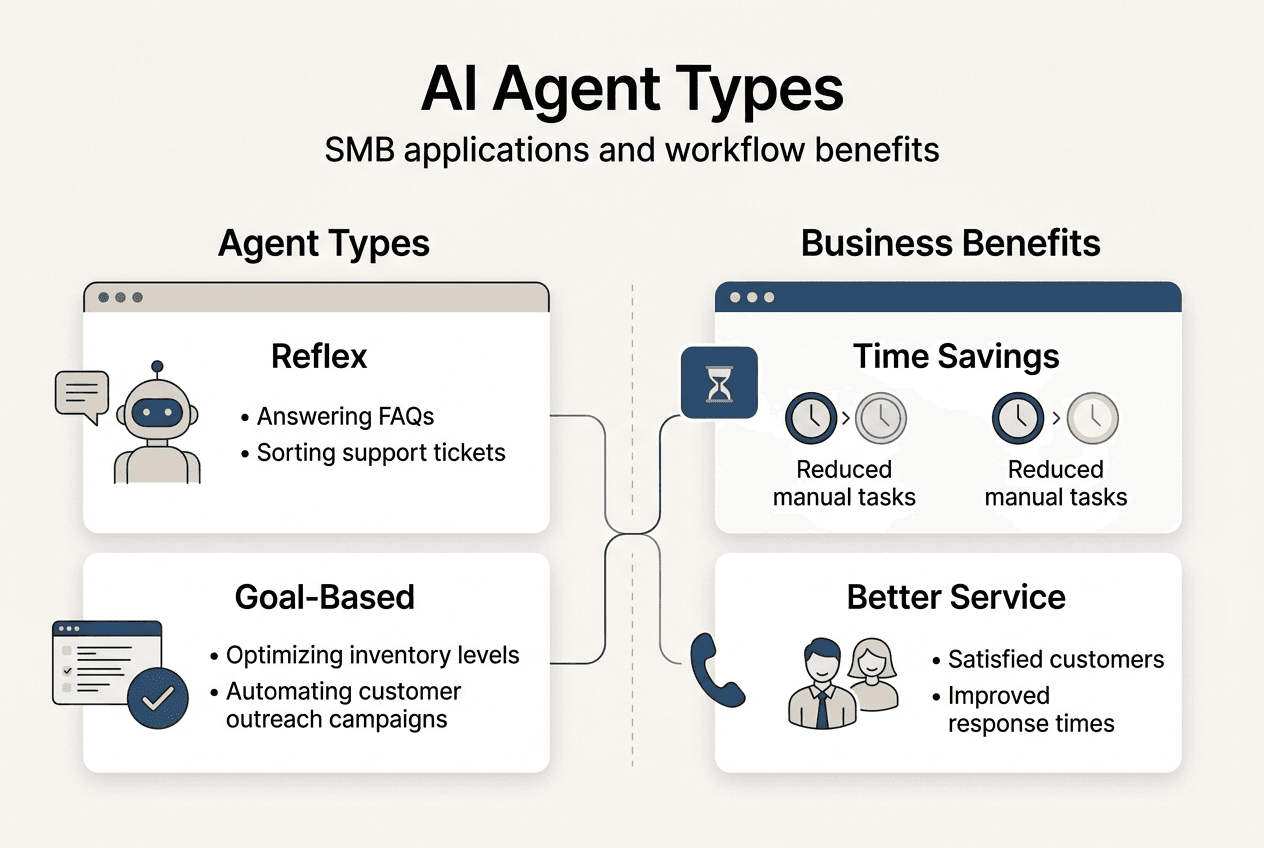
| Agent Type | Key Characteristics | Best SMB Use Cases | | — | — | | Simple Reflex | Rule-based, fast, predictable | Basic customer FAQs, simple data entry | | Model-Based | Tracks state changes, contextual | Order tracking, appointment scheduling | | Goal-Based | Works toward objectives | Lead qualification, workflow optimization | | Utility-Based | Optimizes for value | Resource allocation, pricing decisions | | Learning | Improves over time | Content personalization, demand forecasting | | Multi-Agent | Collaborative specialists | Complex customer journeys, supply chain coordination |
For most SMBs, the practical applications break down like this:
- Customer service automation works best with model-based or goal-based agents that maintain conversation context and work toward resolution
- Marketing support benefits from utility-based agents that optimize campaign performance and budget allocation
- Supply chain management requires multi-agent systems coordinating inventory, ordering, and logistics
- Sales lead qualification suits goal-based agents focused on identifying high-value prospects
Pro Tip: Start with simpler agent types for initial deployments to minimize costs and complexity, then graduate to multi-agent systems as you gain operational experience and identify workflows requiring sophisticated coordination.
Multi-agent systems deliver impressive results for complex operations but introduce coordination challenges and higher failure risks. When multiple agents share information and decision-making, one agent’s error can cascade through the entire system. The enterprise AI agent concepts resource provides deeper architectural insights for businesses considering advanced implementations.
Benefits and ROI of AI agents for small and medium businesses
The business case for AI agents rests on hard data, not hype. A comprehensive study of 320 SMB users revealed compelling ROI metrics that should interest any business leader focused on operational efficiency.
| Metric | Result | Context | | — | — | | Time Savings | 85-95% | On repetitive, text-heavy tasks | | Payback Period | 3-6 months | Typical timeframe to recover investment | | Revenue Growth | 93% report increases | Among SMBs deploying AI agents | | Positive ROI | 91% achieve | Within first year of implementation | | Customer Satisfaction | 40% improvement | In businesses automating support |
SMBs report 85-95% time savings on repetitive tasks and rapid payback in 3-6 months with AI agents. These aren’t marginal improvements. They represent fundamental shifts in how work gets done. Tasks that consumed entire workdays now complete in minutes, freeing your team for high-value activities that actually grow the business.
The financial impact extends beyond time savings. 93% of SMBs using AI agents report revenue growth and 91% positive ROI. Revenue increases stem from faster customer response times, improved lead conversion rates, and the ability to handle more business without proportional staff increases.
The top five benefits SMBs experience when implementing AI agents include:
- Productivity multiplication through 24/7 operation and instant task execution across multiple systems simultaneously
- Cost reduction by automating labor-intensive processes and eliminating errors that require expensive corrections
- Accuracy improvements as AI agents follow defined processes consistently without fatigue or distraction
- Scalability to handle demand spikes without hiring, training, or overwhelming existing staff
- Competitive advantage by delivering faster, more personalized customer experiences than competitors still using manual processes
“The businesses seeing the strongest ROI from AI agents share one trait: they started with clearly defined, high-volume workflows where automation could deliver immediate measurable impact, then expanded from those successes.”
Many SMB leaders worry about upfront costs. Reality check: most AI agent implementations for small businesses cost less than hiring a single full-time employee, and they pay for themselves within a quarter or two through efficiency gains. The initial investment includes setup, integration with existing systems, and training, but ongoing costs remain predictable and scale with usage.
Customer-facing benefits matter too. Faster response times, personalized interactions based on complete customer history, and consistent service quality regardless of time or day build customer loyalty and reduce churn. AI automation reshaping enterprise operations demonstrates how these principles apply across business sizes and industries.
Managing risks and best practices for AI agent deployment
Every powerful technology carries risks. AI agents are no exception. Understanding potential failure modes and implementing proper safeguards separates successful deployments from expensive mistakes.
Failures include hallucinations, error propagation, context overload, and multi-agent coordination issues. Hallucinations occur when AI agents generate plausible-sounding but factually incorrect information. An agent might confidently tell a customer their order shipped when it hasn’t, creating service problems and eroding trust.
Error propagation poses particular danger in multi-step workflows. An AI agent misreads a customer’s intent in step one, then executes five subsequent actions based on that flawed understanding. By the time a human notices, the agent has sent incorrect emails, updated wrong records, and potentially damaged customer relationships. Early errors compound quickly.
Common risks SMBs face when deploying AI agents:
- Hallucinated information damaging customer trust and requiring costly corrections
- Cascading errors from early workflow mistakes multiplying through subsequent automated actions
- Prompt injection attacks where malicious inputs manipulate agent behavior
- Context overload when agents lose track of relevant information in complex, long-running tasks
- Multi-agent coordination failures where agents work at cross-purposes or duplicate efforts
- Privacy breaches if agents access or share sensitive data inappropriately
Hybrid human-AI loops and graduated autonomy help mitigate risks in SMB deployments. Graduated autonomy means starting with human-activated agents that execute only when a person approves, then slowly expanding to fully autonomous operation as you build confidence and refine processes.
Human-activated agents offer a smart middle ground. The AI agent does the heavy lifting, analyzing data, drafting responses, and preparing actions, but a human reviews and approves before execution. You gain most efficiency benefits while maintaining quality control and catching errors before they impact customers.
Pro Tip: Implement monitoring dashboards that flag unusual agent behaviors, set up regular human audits of agent decisions, and establish clear escalation protocols for situations agents can’t handle confidently, creating safety nets without sacrificing efficiency.
Start your AI agent journey with text-heavy, high-volume tasks that have clear success criteria. Customer email responses, data entry, appointment scheduling, and basic troubleshooting make excellent first projects. These workflows deliver quick wins, build organizational confidence, and provide learning opportunities before tackling more complex automation.
Governance matters. Establish policies defining what agents can and cannot do, who oversees them, how often humans review their work, and what triggers immediate human intervention. Document these policies and train your team on them. The SimplyAI AI agents services approach emphasizes governance frameworks tailored to SMB needs and resources.
For deeper insights on implementing effective governance, the Agentic AI lessons from McKinsey report shares practical frameworks from organizations successfully deploying AI agents at scale.
Enhance your business with SimplyAI’s AI agent solutions
Understanding AI agents is one thing. Implementing them effectively is another. SimplyAI specializes in designing and deploying AI agents tailored specifically for small and medium businesses looking to automate processes and enhance customer experiences without the complexity of enterprise-scale solutions.
We focus on practical implementations that deliver measurable results quickly. Our AI agents service handles everything from initial workflow analysis to deployment and ongoing optimization. We help you identify high-impact automation opportunities, build agents suited to your specific needs, and implement the governance frameworks that ensure reliable operation.
Beyond standalone agents, our AI and automations services integrate AI capabilities across your entire operation, connecting customer service, marketing, sales, and operations into cohesive automated workflows. Whether you need a single agent handling customer inquiries or a multi-agent system coordinating complex business processes, we build solutions that fit your scale and budget.
“At SimplyAI, we believe every small and medium business deserves AI superpowers. Our mission is making sophisticated AI agent technology accessible, affordable, and actually useful for companies ready to compete in 2026 and beyond.”
Ready to explore how AI agents can transform your operations? Visit SimplyAI to learn more about our approach, see real client results, and start a conversation about your specific automation needs.
What is an AI agent? Frequently asked questions
What distinguishes an AI agent from a chatbot?
Chatbots handle single-turn conversations, responding to individual queries without maintaining context or executing multi-step workflows. AI agents autonomously perceive situations, reason through problems, plan sequences of actions, execute across multiple systems, and learn from outcomes. A chatbot answers questions; an AI agent solves problems end-to-end.
How quickly can SMBs expect ROI from AI agents?
Most SMBs achieve positive ROI within 3-6 months of deploying AI agents. The exact timeline depends on implementation scope and the workflows you automate. High-volume, repetitive tasks like customer email management or data entry typically show returns fastest, often within weeks of going live.
What are key risks SMBs should prepare for?
The main risks include hallucinations where agents generate incorrect information, error cascades from early workflow mistakes, and coordination failures in multi-agent systems. Mitigate these through human-activated deployment initially, robust monitoring, regular audits, and clear governance policies defining agent boundaries and escalation protocols.
Which types of AI agents suit small businesses best?
Most SMBs start with model-based or goal-based agents for customer service and operational workflows. These offer good balance between capability and complexity. Simple reflex agents work for basic FAQs, while utility-based agents excel at optimization tasks like marketing spend allocation. Multi-agent systems make sense only after you’ve mastered simpler implementations.
How can SMBs start implementing AI agents safely?
Begin with human-activated agents on clearly defined, high-volume workflows like email responses or appointment scheduling. Let the agent prepare actions but require human approval before execution. Monitor closely, gather feedback, and gradually expand autonomy as you build confidence. Partner with experienced providers like SimplyAI’s AI agents services to avoid common pitfalls and accelerate time to value.