
Many small and medium businesses collect customer data, sales figures, and operational metrics daily, yet struggle to transform this information into timely decisions. The gap between having data and using it effectively costs businesses opportunities every quarter. AI-assisted analytics bridges this divide by automating repetitive data tasks and surfacing insights that drive smarter choices. This guide explains how AI-assisted analytics works and how your business can implement it to gain a competitive edge in 2026.
Table of Contents
- What Is AI-Assisted Analytics And How Does It Work?
- Key Benefits Of AI-Assisted Analytics For Small And Medium Businesses
- Understanding The Difference Between AI And Automation In Analytics
- Implementing AI-Assisted Analytics In Your Business: Practical Steps
- Enhance Your Business With SimplyAI’s AI-Assisted Analytics Solutions
- Frequently Asked Questions
Key takeaways
| Point | Details |
|---|---|
| Automation saves time | Reduces data prep time by up to 80%, freeing analysts for strategic work. |
| Better forecasting | Companies using predictive analytics see 15-20% improved sales forecasting accuracy. |
| Democratized insights | User-friendly AI tools let non-technical teams access data without coding skills. |
| Start small wins | Auditing data first and solving high-impact problems ensures measurable ROI from AI adoption. |
What is AI-assisted analytics and how does it work?
AI-assisted analytics combines artificial intelligence with traditional analytics to help businesses extract actionable insights from raw data faster than manual methods allow. Instead of analysts spending hours cleaning spreadsheets and building reports, AI systems handle these repetitive tasks automatically. This shift frees your team to focus on interpreting results and making strategic decisions.
The technology works through several core components. Machine learning algorithms identify patterns in historical data, flagging anomalies that might indicate problems or opportunities. Natural language processing lets users ask questions in plain English rather than learning complex query languages. Predictive models forecast future trends based on current patterns, helping you anticipate customer needs before competitors do.
AI-assisted analytics automates repetitive data tasks, dramatically speeding the journey from raw numbers to business decisions. For a small retail business, this might mean automatically categorizing thousands of transactions by product type, customer segment, and profitability instead of manually sorting them. The system learns your business logic and applies it consistently across all data.
Key capabilities include:
- Automated data cleaning that removes duplicates and fixes formatting errors
- Pattern recognition that surfaces trends humans might miss in large datasets
- Predictive modeling that forecasts sales, inventory needs, and customer churn
- Natural language interfaces that let anyone ask data questions without technical training
- Real-time dashboards that update automatically as new information arrives
Understanding these fundamentals helps you evaluate which AI-assisted analytics tools fit your specific business needs. The right system integrates with existing data sources and delivers insights in formats your team can act on immediately.
Key benefits of AI-assisted analytics for small and medium businesses
Time savings represent the most immediate benefit SMBs notice after implementing AI-assisted analytics. Automation reduces data preparation time by up to 80%, transforming what once took days into tasks completed in minutes. Your finance team can generate monthly reports automatically rather than manually consolidating data from multiple systems. Marketing teams get customer segmentation analysis without writing complex database queries.

Forecasting accuracy improves significantly when AI models analyze historical patterns and external factors simultaneously. Companies using predictive analytics report 15-20% better sales forecasting accuracy compared to traditional methods. This precision helps you optimize inventory levels, reducing both stockouts and excess carrying costs. Better demand forecasting also improves cash flow planning and resource allocation.
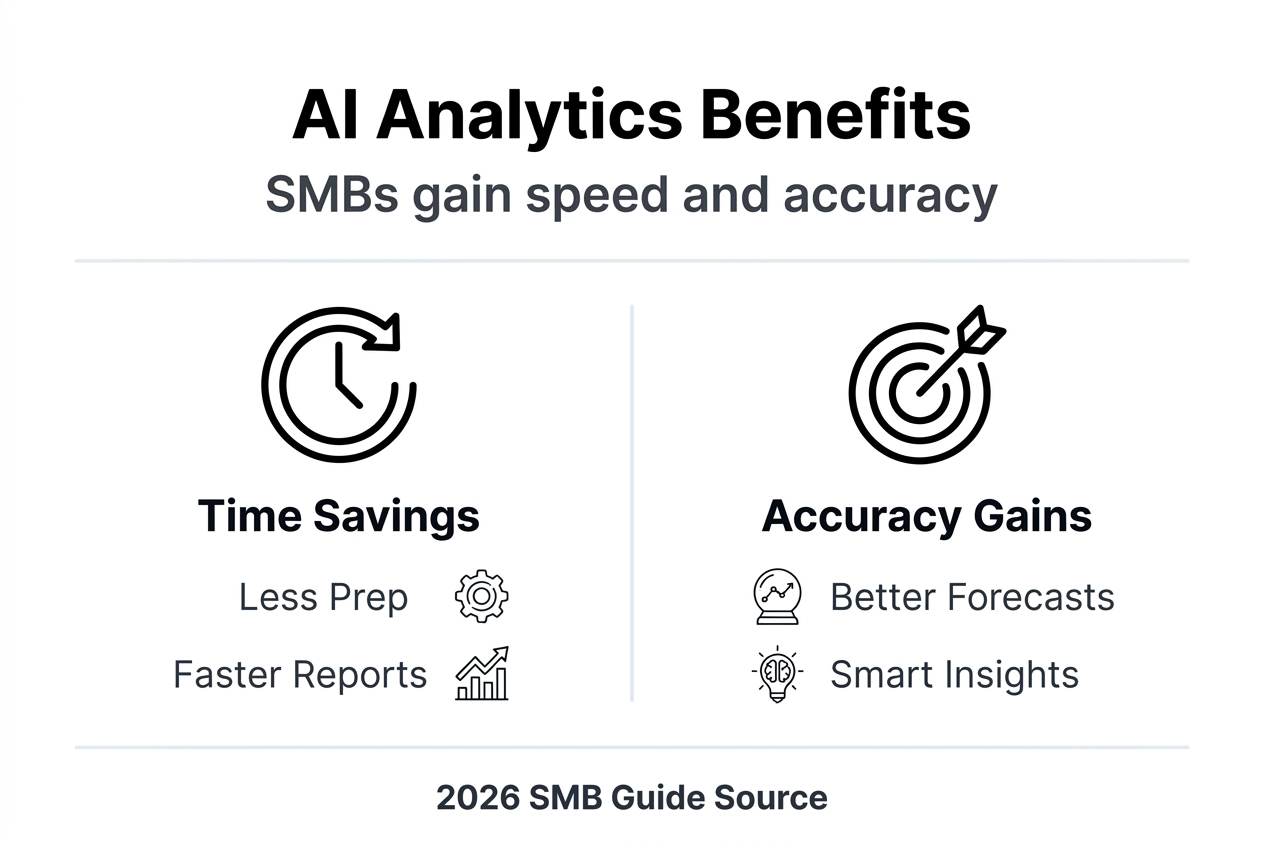
Democratized data access breaks down information silos that typically slow decision making. User-friendly AI tools increase data accessibility, enabling employees across departments to extract insights without depending on IT or data specialists. Your sales manager can analyze win rates by product category. Customer service leads can identify common complaint patterns. Everyone makes evidence-based decisions rather than relying on intuition alone.
Cost efficiency emerges as teams accomplish more analysis with existing headcount. Instead of hiring additional data analysts, you empower current employees with tools that amplify their capabilities. The ROI becomes clear when you compare the cost of AI analytics software against the value of decisions it improves and the staff time it saves.
Competitive advantage grows as you spot market shifts faster than rivals still using manual analysis. Real-time dashboards alert you to changing customer preferences, allowing quick strategy adjustments. Businesses that embrace AI automation make data-driven pivots while competitors wait weeks for monthly reports.
Notable impact: SMBs implementing AI-assisted analytics typically see payback within 6-12 months through improved operational efficiency and better strategic decisions.
Understanding the difference between AI and automation in analytics
Automation executes predefined rules to handle repetitive tasks without human intervention. When you set up a script to export sales data every Monday morning, that’s automation. The system follows exact instructions you programmed, performing the same steps consistently. Traditional automation works perfectly for standardized processes that don’t require judgment or adaptation.
AI simulates human intelligence by learning from data and making decisions in new situations. An AI system analyzing customer behavior doesn’t just follow preset rules. It identifies patterns, adapts to changing conditions, and improves accuracy over time as it processes more examples. Machine learning models discover relationships in data that programmers didn’t explicitly code.
Understanding the difference between AI and automation proves crucial for SMBs choosing the right tools and maximizing ROI. Automation handles known processes efficiently at lower cost. AI tackles complex problems requiring pattern recognition and prediction. Many businesses waste money implementing AI where simple automation would suffice, or miss opportunities by using basic automation where AI could deliver breakthrough insights.
Cost and complexity vary significantly between these approaches. Automation tools typically cost less and require straightforward setup. You define the process once and it runs reliably. AI systems need training data, ongoing monitoring, and occasional retraining as business conditions change. However, AI handles scenarios automation can’t touch, like predicting which customers will churn or recommending optimal pricing strategies.
The smartest approach combines both technologies strategically. Use automation for:
- Scheduled report generation and data exports
- Rule-based data validation and cleaning
- Standardized calculations and aggregations
- Workflow triggers based on specific conditions
Deploy AI for:
- Customer behavior prediction and segmentation
- Anomaly detection in financial transactions
- Dynamic pricing optimization
- Natural language query interfaces
Many effective AI-assisted analytics platforms blend automation’s reliability with AI’s adaptability, giving you the best of both worlds.
Pro Tip: Start by automating repetitive reporting tasks to free up time, then layer in AI for predictive insights as your team builds confidence with data-driven decision making.
Implementing AI-assisted analytics in your business: practical steps
Successful AI adoption starts with honest assessment of your current data landscape. Audit what information you collect, where it lives, and how clean it is. Check if customer records have consistent formatting. Verify that sales data from different channels can be linked together. Poor data quality undermines even the most sophisticated AI tools, so address gaps before investing in new technology.
Next, identify high-impact problems where AI can deliver measurable value quickly. Look for decisions your team makes repeatedly using gut instinct rather than data. Common opportunities include inventory optimization, lead scoring, customer churn prediction, and pricing strategy. Start small with AI implementation by solving one specific problem well rather than attempting enterprise-wide transformation.
Follow these implementation steps:
- Define clear success metrics tied to business outcomes like revenue growth or cost reduction
- Select an AI analytics tool that integrates with your existing systems and matches team skill levels
- Start with a pilot project focused on one department or use case
- Train users thoroughly on interpreting AI insights and taking action on recommendations
- Measure efficiency gains and ROI monthly to prove value and guide expansion
- Scale gradually to additional use cases as you build organizational competence
Building internal capability matters as much as choosing software. Invest in AI corporate education so employees understand how AI works and trust its recommendations. Teams that grasp AI fundamentals spot creative applications and avoid common pitfalls like overfitting models or ignoring edge cases.
| Approach | Best For | Key Advantage | Main Risk |
|---|---|---|---|
| Start Small | Limited budget, risk-averse culture | Proves value before major investment | May miss enterprise-wide efficiencies |
| Full Scale | Urgent competitive pressure, clean data | Faster transformation, immediate impact | Higher upfront cost, change management challenges |
Partner with experts who understand SMB constraints. AI automation specialists can configure systems faster and avoid expensive mistakes that derail internal projects. External support accelerates time to value while building your team’s skills through hands-on collaboration.
Pro Tip: Choose AI tools with visual interfaces and pre-built templates rather than requiring custom coding, so business users can create analyses independently without waiting for IT support.
Monitor results rigorously from day one. Track both technical metrics like model accuracy and business outcomes like decision speed or revenue per customer. This data justifies continued investment and highlights where the AI delivers greatest value. Adjust your approach based on what the numbers reveal rather than assumptions about where AI should help.
Enhance your business with SimplyAI’s AI-assisted analytics solutions
Turning data into decisions shouldn’t require a team of data scientists or massive technology budgets. SimplyAI designs AI automations tailored to SMB needs, connecting your existing systems and surfacing insights that drive growth. Our solutions reduce manual reporting work by automating data preparation, letting your team focus on strategy instead of spreadsheets.
Our AI agents provide conversational interfaces where employees ask business questions in plain language and receive instant, accurate answers backed by your data. No SQL knowledge required. Marketing teams discover customer trends. Operations managers spot efficiency opportunities. Everyone makes smarter choices faster.
We also offer AI corporate education programs that build organizational AI literacy, ensuring your entire team maximizes the value of analytics investments. Start small, measure results, and scale with expert support at every step. Unlock growth through practical AI implementation designed specifically for businesses like yours.
Frequently asked questions
What is AI-assisted analytics?
AI-assisted analytics combines artificial intelligence with traditional data analysis to automate repetitive tasks and surface insights faster than manual methods. The technology handles data cleaning, pattern recognition, and predictive modeling while allowing business users to ask questions in natural language. This approach makes sophisticated analytics accessible to teams without specialized data science training.
How does AI-assisted analytics improve business decision-making?
AI analytics accelerates the journey from raw data to actionable insights by automating time-consuming preparation work. Predictive models forecast customer behavior, market trends, and operational needs with greater accuracy than traditional methods. Teams make evidence-based decisions quickly rather than relying on delayed reports or intuition, improving outcomes across sales, marketing, and operations.
What should small businesses consider before adopting AI-assisted analytics?
Assess your current data quality and availability before investing in AI tools, since accurate insights require clean, consistent information. Define clear business metrics you want to improve, like sales forecast accuracy or customer retention rates. Start with manageable projects that solve specific problems rather than attempting enterprise-wide transformation, proving ROI before scaling investment.
Can non-technical users benefit from AI-assisted analytics tools?
Modern AI analytics platforms feature visual interfaces and natural language query capabilities that eliminate coding requirements. Employees across departments can explore data, generate reports, and discover insights independently without IT support. However, organizations should provide training on interpreting AI recommendations and implement appropriate data governance to maintain security while democratizing access.