
Most small business owners believe AI can handle 90% of customer support automatically. Reality check: AI systems fail 70% of basic tasks when deployed without human oversight. The gap between AI hype and actual capability creates confusion for SMBs exploring automated support solutions. This guide cuts through the noise to reveal what AI-powered support genuinely delivers, where it falls short, and how smart businesses blend automation with human expertise to enhance customer experience while controlling costs.
Table of Contents
- Key takeaways
- Understanding AI-powered support: core technologies and methodologies
- Common limitations and challenges of AI-powered support
- Realistic benefits of AI-powered support for small businesses
- Implementing AI-powered support: best practices and hybrid approach
- Explore SimplyAI’s AI-powered support solutions for your business
- Frequently asked questions
Key Takeaways
| Point | Details |
|---|---|
| Automate routine inquiries | AI powered support automates repetitive questions to reduce handling time and costs while keeping humans for fallbacks when needed. |
| Hybrid human AI support | Combine AI automation for simple queries with human escalation for complex or emotional issues to sustain quality. |
| RAG based responses | RAG pulls information from current knowledge bases in real time to avoid outdated or incorrect answers. |
| No code deployment | No code tools let SMBs implement AI without heavy technical effort. |
| Deflection potential | With proper training on real conversations, AI can deflect thirty to fifty percent of inquiries away from human agents. |
Understanding AI-powered support: core technologies and methodologies
AI-powered support uses chatbots, predictive analytics, and agent-assist tools to automate customer service workflows. These systems handle repetitive queries while enabling proactive engagement for small and medium businesses. The technology stack typically includes three core components working together to reduce manual workload.
Chatbots serve as the first line of defense, intercepting common questions about hours, pricing, or order status. Agent-assist tools surface relevant knowledge articles to human representatives during live conversations, cutting resolution time by 40%. Predictive analytics identify patterns in customer behavior, allowing businesses to address issues before customers reach out. This proactive approach reduces ticket volume and improves satisfaction scores.
The automation focuses on tier-1 inquiries where answers follow predictable patterns. Password resets, tracking updates, and FAQ responses represent ideal use cases. Deflection rates of 30-50% are realistic when AI systems receive proper training on actual customer conversations. Higher deflection requires extensive knowledge bases and continuous refinement based on real interactions.
Retrieval-Augmented Generation (RAG) represents the methodology powering accurate AI responses. Instead of relying on pre-trained knowledge that becomes outdated, RAG systems pull information from your current documentation in real time. When a customer asks about return policies, the AI retrieves the exact policy from your knowledge base rather than guessing based on training data. This approach dramatically reduces hallucinations and incorrect information.
Implementation begins with ticket audits to identify repetitive patterns. You analyze three months of support conversations to find the 20-30 questions consuming most agent time. These become your automation targets. Intent detection algorithms categorize incoming messages, routing simple queries to AI and complex issues to humans. Escalation workflows ensure smooth handoffs when AI reaches its limits, preserving customer experience during the transition.
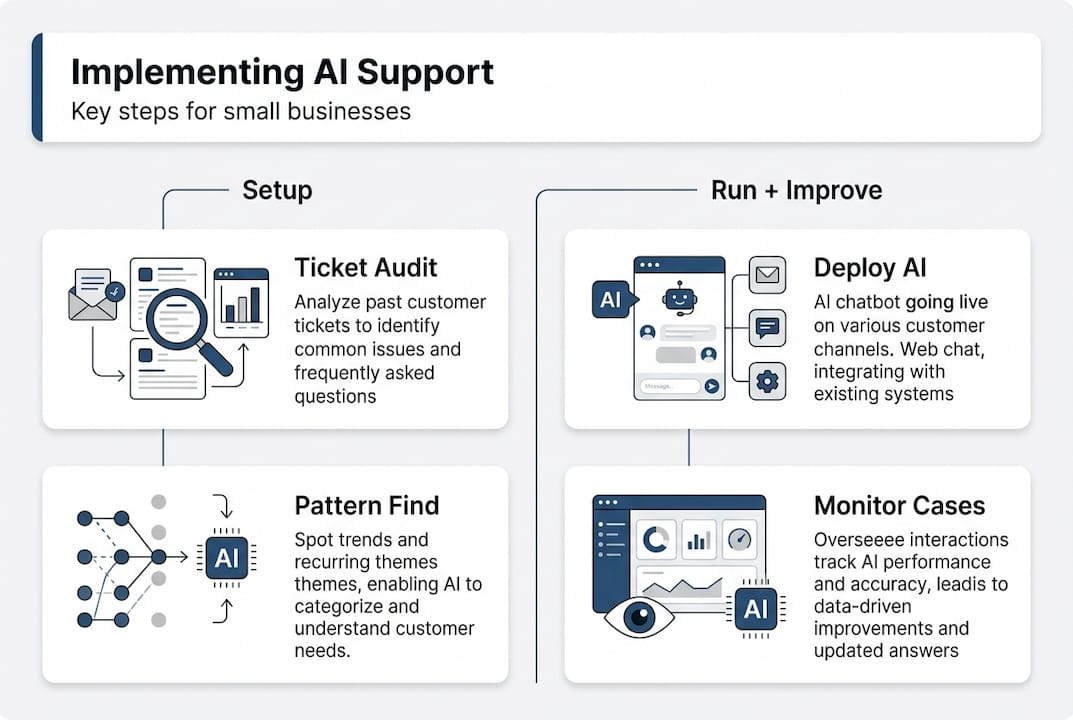
Pro Tip: Focus your initial AI deployment on the five most frequent customer questions. Achieving 80% accuracy on these five queries delivers more value than 50% accuracy across twenty topics.
Key components working together:
- Natural language processing interprets customer intent from conversational messages
- Knowledge base integration provides AI with current, accurate information sources
- Sentiment analysis detects frustration levels to trigger human escalation
- Multi-channel deployment handles inquiries across email, chat, and social platforms
Explore SimplyAI’s AI tools to see how these technologies integrate into existing business workflows without requiring technical expertise.
“The most effective AI support systems augment human capabilities rather than attempting full replacement, creating efficiency gains while maintaining the empathy customers expect.”
Common limitations and challenges of AI-powered support
AI systems struggle with emotional complaints, complex reasoning, and novel issues that fall outside training data patterns. Multi-hop queries requiring information synthesis from multiple sources frequently produce incomplete or incorrect responses. A customer asking about return eligibility while also inquiring about exchange options and refund timing creates the type of layered question where AI falters. Human agents excel at these nuanced scenarios by understanding context and business priorities simultaneously.
Emotional intelligence remains AI’s critical weakness. When customers express frustration about delayed shipments or billing errors, they need empathy and problem-solving flexibility. AI responses often sound robotic or dismissive, escalating rather than resolving tensions. Studies show that poor documentation and hallucinations cause 70% failure rates on basic customer service tasks when knowledge bases lack depth or currency. The technology confidently delivers wrong answers, damaging trust and requiring human intervention to repair relationships.
Over-reliance on automation creates significant risks for small businesses building customer loyalty. Customers detecting they are speaking with AI often disengage or demand human contact immediately. This reaction stems from past experiences with unhelpful automated systems that waste time before reaching actual assistance. Your support strategy must account for this skepticism by making human escalation seamless and obvious.
Edge cases represent another major challenge. Every business encounters unusual situations like custom orders, special accommodations, or policy exceptions. AI trained on standard procedures cannot navigate these scenarios requiring judgment calls. A customer requesting expedited shipping due to a family emergency needs human discretion to waive fees or find creative solutions. Automated systems default to rigid rule enforcement, missing opportunities to build lasting customer relationships through flexibility.
Knowledge base quality directly determines AI accuracy. Outdated documentation, incomplete articles, or conflicting information across sources cause AI to hallucinate plausible-sounding but incorrect responses. Maintaining documentation requires ongoing investment as products, policies, and procedures evolve. Small businesses often underestimate this maintenance burden when budgeting for AI implementation.
Common AI failure patterns:
- Misinterpreting slang, regional expressions, or industry-specific terminology
- Providing technically correct but contextually inappropriate responses
- Failing to recognize when customers need escalation to specialized departments
- Repeating the same unhelpful answer when customers rephrase questions
Hybrid human-AI models address these limitations by routing appropriate queries to automation while preserving human judgment for complex cases. Centralized AI intelligence strategies help businesses maintain consistency across automated and human-assisted interactions. Understanding these constraints prevents unrealistic expectations and guides effective implementation focused on genuine automation opportunities.
“The gap between AI marketing promises and operational reality creates disillusionment when businesses deploy systems expecting human-level performance across all support scenarios.”
Learn how other businesses handle AI edge cases in specialized applications requiring human oversight.
Realistic benefits of AI-powered support for small businesses
Small businesses automate 30-70% of tickets by focusing on repetitive queries, achieving ROI in under 90 days with proper training on real customer data. The financial impact comes from reduced response times, lower staffing costs for routine inquiries, and improved customer satisfaction through 24/7 availability. A business handling 500 monthly support tickets can deflect 200-300 to AI, freeing agents for revenue-generating activities like sales support or complex problem resolution.
Ticket deflection represents the primary metric for measuring AI success. Each automated interaction costs pennies compared to dollars for human handling. Fast ROI timelines depend on implementation quality rather than technology sophistication. Businesses starting with thorough ticket audits and focused knowledge bases see returns within three months. Those deploying AI without preparation waste six months troubleshooting poor accuracy before achieving useful deflection rates.
| Metric | Typical Improvement | Business Impact |
|---|---|---|
| First response time | 60-80% faster | Higher customer satisfaction scores |
| Ticket deflection | 30-50% of volume | Reduced staffing costs for tier-1 support |
| After-hours coverage | 24/7 availability | Captures inquiries outside business hours |
| Agent productivity | 40% time savings | Staff focuses on complex, high-value interactions |
| Customer satisfaction | 15-25% CSAT increase | Improved retention and referral rates |
Implementation follows a proven sequence. Start with ticket audits analyzing three months of conversations to identify repetitive patterns. Build 15-40 knowledge base articles covering these common scenarios with clear, tested answers. Deploy no-code AI tools like Intercom, Zendesk, or HubSpot that integrate with existing systems without requiring developer resources. Run a pilot phase monitoring accuracy and customer feedback before full rollout.
No-code platforms democratize AI access for small businesses lacking technical teams. These tools provide visual interfaces for training AI on your documentation, setting escalation rules, and monitoring performance metrics. Monthly costs range from $50 to $500 depending on ticket volume and feature requirements. The investment pays back quickly when compared to hiring additional support staff.
Continuous training with real customer data improves accuracy over time. AI learns from successful interactions and corrections made by human agents during escalations. This feedback loop requires minimal ongoing effort but delivers compounding returns as the system handles more query types confidently. Businesses updating knowledge bases monthly maintain accuracy above 85% while those neglecting maintenance see performance degrade to 60% within six months.
Pro Tip: Track escalation reasons weekly during your first 90 days. Patterns reveal knowledge gaps to address through documentation updates rather than assuming AI limitations.
Step-by-step implementation approach:
- Audit 500-1000 recent tickets to identify the 20 most common question types
- Document clear answers in a centralized knowledge base with examples
- Configure AI to handle these 20 scenarios with human escalation for uncertainty
- Monitor accuracy and customer sentiment for two weeks before expanding scope
- Add five new question types monthly based on escalation pattern analysis
Explore practical AI business implementation strategies tailored for small business constraints and resources.
Implementing AI-powered support: best practices and hybrid approach
Hybrid human-AI support models augment human agents rather than replacing them, maintaining engagement while solving complex cases efficiently. This balanced approach recognizes AI’s strengths in handling repetitive tasks at scale while preserving human empathy for emotionally charged or novel situations. Small businesses adopting hybrid models report higher customer satisfaction and staff morale compared to full automation attempts.
The hybrid model operates through intelligent routing. Simple queries about hours, pricing, or order status flow to AI for instant resolution. Complaints, refund requests, or technical troubleshooting route to human agents equipped with AI-generated context and suggested responses. This division of labor maximizes efficiency without sacrificing service quality. Customers receive fast answers for straightforward questions and thoughtful assistance for complicated issues.
| Approach | Strengths | Weaknesses | Best For |
|---|---|---|---|
| Full automation | Lowest cost per ticket, 24/7 coverage | Poor handling of complex cases, customer frustration | High-volume, simple inquiries only |
| Hybrid model | Balanced efficiency and quality, scalable | Requires ongoing training and monitoring | Most small businesses seeking growth |
| Human-only support | Maximum flexibility and empathy | High costs, limited hours, inconsistent quality | Premium services or highly technical products |
Implementation best practices follow a structured sequence:
- Conduct comprehensive ticket audits identifying automation opportunities and escalation triggers
- Build a knowledge base with 15-40 articles covering common scenarios using clear language
- Deploy AI in pilot mode handling 20% of incoming tickets while monitoring accuracy
- Train support staff on escalation workflows and using AI-generated insights
- Monitor KPIs weekly including deflection rate, CSAT, escalation volume, and resolution time
- Update knowledge base monthly based on escalation patterns and customer feedback
- Gradually expand AI scope as accuracy stabilizes above 85% for existing query types
Preserving human empathy remains critical for customer relationships. Edge cases requiring policy exceptions, emotional support during problems, or creative problem-solving demand human judgment. AI provides efficiency gains for routine work, freeing agents to deliver exceptional service where it matters most. This division creates job satisfaction for support staff who spend time on meaningful interactions rather than repetitive questions.
Pro Tip: Introduce AI gradually to maintain team morale. Start with after-hours coverage where AI provides clear value without threatening jobs, then expand to routine inquiries during business hours as staff sees benefits.
Staff training focuses on collaboration with AI rather than competition. Agents learn to review AI-generated response suggestions, correct errors, and identify knowledge gaps. This feedback loop improves system accuracy while giving staff ownership of AI performance. Businesses investing in this training see faster adoption and better outcomes than those treating AI as a black box.
Knowledge base maintenance requires dedicated resources. Assign one team member to review escalations weekly, updating documentation to address gaps. This ongoing investment prevents accuracy degradation and ensures AI remains helpful as products and policies evolve. Small businesses often underestimate this requirement, leading to declining performance after initial success.
Develop your AI-first organizational strategy to integrate automated support with broader business operations. Partner with experienced providers like SupraITS for technical infrastructure supporting AI deployment.
Explore SimplyAI’s AI-powered support solutions for your business
Small businesses need AI support systems that integrate seamlessly with existing workflows without requiring technical expertise or large budgets. SimplyAI specializes in no-code AI automations and agent-assist tools designed specifically for SMB constraints and growth goals.
Our solutions handle the complete implementation journey from ticket audits through knowledge base creation to ongoing optimization. We focus on fast ROI by targeting your highest-volume repetitive queries first, delivering measurable deflection within 60 days. Expert guidance ensures your hybrid model balances automation efficiency with human empathy for complex customer needs.
Explore AI automations tailored for customer support workflows or discover AI agents that augment your team’s capabilities. Visit SimplyAI to start your AI-powered support journey with solutions proven for small business success.
Frequently asked questions
What are the main components of AI-powered support?
Chatbots handle initial customer inquiries by answering common questions about products, policies, and orders automatically. Predictive analytics anticipate customer needs by identifying patterns in behavior and support history. Agent-assist tools surface relevant knowledge articles to human representatives during live conversations, reducing resolution time. RAG methods retrieve current information from your documentation rather than relying on outdated training data. Escalation workflows ensure smooth handoffs when AI encounters queries beyond its capability, preserving customer experience.
How can small businesses measure the success of AI support implementation?
Track ticket deflection rates showing the percentage of inquiries resolved without human intervention, targeting 30-50% for tier-1 queries. Monitor customer satisfaction scores through post-interaction surveys, aiming for CSAT improvements of 15-25% over baseline. Measure response time reductions, with AI typically delivering 60-80% faster first responses than human-only support. Calculate ROI by comparing automation costs against savings from reduced staffing needs for routine inquiries. Review escalation volumes weekly to ensure complex cases receive appropriate human attention without bottlenecks.
What are typical challenges when deploying AI-powered support?
AI hallucinations occur when systems generate plausible-sounding but incorrect responses due to poor knowledge base quality or ambiguous queries. Incomplete or outdated documentation causes accuracy problems requiring ongoing maintenance investment. Emotional customer interactions need human empathy that AI cannot replicate, risking satisfaction damage if not escalated properly. Multi-hop queries synthesizing information from multiple sources frequently produce incomplete answers. Ongoing human oversight through weekly escalation reviews and monthly knowledge base updates addresses these challenges and maintains performance above 85% accuracy.
Why is a hybrid human-AI model recommended for customer support?
AI excels at handling repetitive, high-volume tasks like password resets, order tracking, and FAQ responses at scale and low cost. Humans manage emotional complaints, complex troubleshooting, and novel problems requiring judgment calls or policy exceptions. This balance improves operational efficiency by deflecting 30-70% of routine tickets while maintaining customer engagement through empathetic handling of difficult situations. Hybrid models prevent the alienation and frustration customers experience with full automation attempts. Staff morale improves when agents focus on meaningful problem-solving rather than repetitive questions, creating better outcomes for businesses, customers, and support teams.