
Most small business owners think automation means replacing a spreadsheet with a script or setting up an auto-reply email. That assumption is costing them real money. Business Process Automation covers far more than routine data entry. It streamlines the core operational workflows that drive your business forward, from customer onboarding to invoicing to lead nurturing. This guide breaks down what business automation actually means for SMBs, which processes to target first, which tools deliver results, and how to build a strategy that sticks.
Table of Contents
- Understanding business automation for SMBs
- Key processes ripe for automation in small businesses
- Popular AI tools and solutions for business automation
- The business case: Real-world results and benchmarks
- How to ensure automation success in your business
- Explore custom AI automation solutions for your business
- Frequently asked questions
Key Takeaways
| Point | Details |
|---|---|
| Automation goes beyond tasks | Business automation streamlines entire workflows, not just single manual tasks. |
| Success starts with the right process | Prioritizing high-volume, repetitive, rule-based processes unlocks the biggest gains. |
| Measurable ROI is achievable | Automation can deliver 15-50% productivity gains and significant savings if well-executed. |
| Pitfalls can be avoided | Most failures are due to poor process selection and lack of ongoing support, not the technology itself. |
| SMBs can start small and scale | Begin with pilot projects and expand as you see measurable results. |
Understanding business automation for SMBs
Business automation, formally known as Business Process Automation (BPA), is the use of advanced technology to handle complex, multi-step operational workflows with minimal human intervention. It is not the same as writing a macro in Excel or scheduling a social media post. Those are single-task automations. BPA connects systems, people, and data across entire processes.
“Business automation focuses on core operational workflows that go beyond routine data entry, using advanced technologies to run the business more effectively.”
For an SMB, this distinction matters enormously. When you automate a single task, you save minutes. When you automate a workflow, you save hours and eliminate entire categories of error. Consider what happens when a new client signs a contract: a fully automated onboarding workflow can trigger a welcome email, create a CRM record, assign a team member, generate an invoice, and schedule a follow-up call without anyone lifting a finger.
The competitive pressure on small businesses is intensifying. Larger competitors have dedicated operations teams. Automation is how SMBs level that playing field. Exploring proven business automation strategies is no longer optional for businesses that want to scale without proportionally scaling headcount.
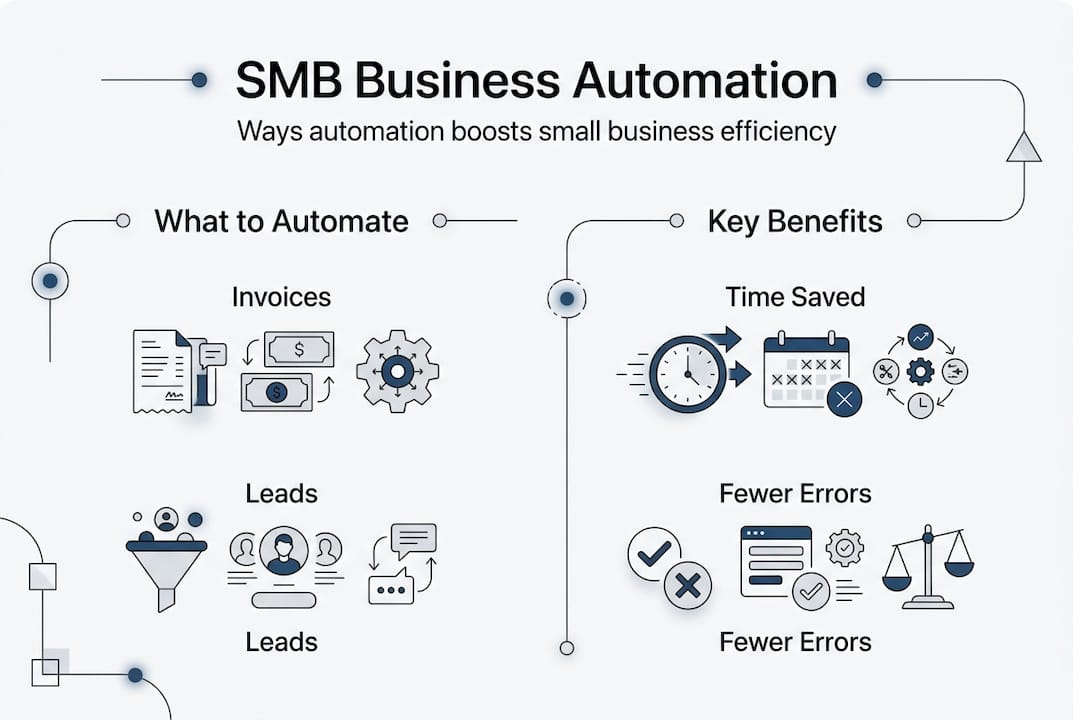
Common processes that SMBs automate successfully include:
- Invoicing and accounts receivable: Automated reminders, payment matching, and reconciliation
- Customer onboarding: Triggered sequences that guide new clients through setup steps
- Customer support: AI chatbots that handle tier-one inquiries around the clock
- Lead nurturing: Automated email sequences based on prospect behavior
- HR and compliance: Onboarding paperwork, time tracking, and policy acknowledgments
Key processes ripe for automation in small businesses
With the basics covered, let’s see which business activities are best suited for automation and how to systematically evaluate them. Not every process is a good candidate. The best targets share a specific profile: they are high-frequency, rule-based, and produce measurable outputs.
Key methodologies for SMBs include identifying repetitive, high-volume, rule-based processes, evaluating suitability by repetitiveness, volume, complexity, and standardization, then prioritizing high-impact, low-complexity tasks. A practical framework looks like this:
- List every recurring process your team handles weekly or monthly
- Categorize each by department: finance, sales, operations, support
- Evaluate each process for repetitiveness, volume, and rule-based logic
- Prioritize tasks where errors are costly or time investment is high
- Pilot one automation before scaling across the organization
Pro Tip: Map the process on paper before you automate it. If the workflow is broken or inconsistent, automation will amplify the chaos, not fix it.
Here is a quick comparison to help you decide where to start:
| Process | Automation potential | Typical time saved |
|---|---|---|
| Invoice generation | Very high | 70-90% |
| Lead follow-up emails | High | 60-80% |
| Employee onboarding | High | 50-70% |
| Customer support (tier 1) | Very high | 40-60% |
| Financial reporting | Medium | 30-50% |
Understanding the different automation types for SMBs helps you match the right technology to each process category, avoiding over-engineering simple tasks or under-investing in complex ones.
Popular AI tools and solutions for business automation
Once you have identified what to automate, picking the right tools makes or breaks your results. The SMB automation landscape has matured significantly, and several platforms now offer enterprise-grade capability at accessible price points.

Common AI tools for SMB automation include Zapier for workflow connections, Nextiva for customer service automation, Salesforce for CRM, QuickBooks for finance, and n8n for low-code custom workflows. Here is how they compare across key dimensions:
| Tool | Primary use case | Best for |
|---|---|---|
| Zapier | App-to-app workflow automation | Non-technical teams |
| n8n | Low-code custom workflows | Teams needing flexibility |
| Nextiva | Customer communication automation | Service-heavy businesses |
| Salesforce | CRM and sales automation | Growing sales teams |
| QuickBooks | Financial process automation | Finance and invoicing |
Beyond these platforms, AI agents represent a significant leap forward. Unlike rule-based tools that follow fixed logic, AI agents for SMBs can reason, adapt, and handle exceptions autonomously. They are particularly effective in customer-facing roles.
For businesses dealing with high support volumes, AI-powered support solutions can resolve common inquiries instantly, escalate complex cases intelligently, and operate continuously without staffing costs. The result is faster response times and higher customer satisfaction without adding headcount.
The key is not to adopt every tool available. Start with one platform that addresses your highest-priority process, master it, then expand. Tool sprawl is one of the leading causes of automation project failure, a point we will address directly in the next section.
The business case: Real-world results and benchmarks
Knowing the power and limitations of automation helps set realistic expectations. The data on automation ROI is compelling, but it comes with important caveats.
Empirical benchmarks show 15-50% productivity gains across industries, with invoice processing delivering 75-90% reductions in cost and time. One manufacturing case study recorded a 300% ROI within eight months of deployment. These are not outliers. They reflect what well-implemented automation consistently delivers.
A specific example: an n8n workflow automation reduced processing time by a factor of 151 while achieving a 0% error rate on a task that previously required manual review. That kind of result is achievable when the right process meets the right tool.
However, the failure rate is sobering. 70-85% of automation projects fail to deliver expected results, and only 26-30% of SMBs reach full automation ROI. The reasons are consistent:
- Poor process selection: Automating the wrong workflows first
- No success metrics: Failing to define what good looks like before launch
- Maintenance neglect: Automated workflows break when connected systems update
- Tool sprawl: Using too many uncoordinated platforms that create new complexity
Pro Tip: Before launching any automation, define three measurable outcomes you expect: time saved per week, error rate reduction, and cost per transaction. Without these benchmarks, you cannot prove value or justify further investment.
The businesses that achieve strong AI automation results share one trait: they treat automation as an ongoing operational discipline, not a one-time project. They also invest in AI for sales automation as a growth lever, not just a cost-cutting measure.
How to ensure automation success in your business
Ready to move from examples and advice to action? These steps translate the research into a practical path forward for any SMB, regardless of technical sophistication.
The foundational principle is clear: fix processes first, then automate. Automating a broken workflow does not solve the problem. It accelerates it. Process mapping, even a simple flowchart, reveals gaps, redundancies, and handoff failures before technology enters the picture.
- Map your top five processes end-to-end before selecting any tool
- Identify the single highest-impact process and pilot automation there first
- Set measurable baselines: current time per task, error frequency, cost per unit
- Choose one tool that fits the process, not the most popular platform
- Run the pilot for 30-60 days and compare results against your baseline
- Refine before scaling: fix edge cases and exceptions before expanding
Pro Tip: Use low-code tools like n8n or Zapier for your first automation. They allow rapid iteration without developer dependency, which means faster learning and lower risk.
Ongoing optimization is where most SMBs fall short. Automated workflows require monitoring. Connected apps update, data formats change, and business rules evolve. Schedule a monthly review of each active automation to catch failures before they affect customers or finances.
Exploring adaptive AI automation approaches helps businesses build workflows that adjust to changing conditions rather than breaking under them. Similarly, AI document processing can eliminate one of the most time-consuming manual tasks in any SMB: extracting, validating, and routing information from contracts, invoices, and forms.
The businesses winning with automation in 2026 are not the ones with the most tools. They are the ones with the clearest processes, the most disciplined measurement, and the willingness to iterate continuously.
Explore custom AI automation solutions for your business
The gap between knowing what automation can do and actually implementing it effectively is where most SMBs get stuck. Strategy is clear. Execution is hard. That is where expert guidance changes the outcome.
At SimplyAI, we design and implement AI automations tailored to the specific workflows, tools, and goals of your business. Whether you need to streamline customer support, automate your sales pipeline, or connect your existing systems into a unified workflow, we build solutions that deliver measurable results from day one. Our AI agents go further, handling complex, multi-step tasks autonomously so your team can focus on work that actually requires human judgment. If you are ready to move from manual processes to intelligent automation, we are ready to help you get there.
Frequently asked questions
What is the difference between task automation and business automation?
Task automation handles a single repetitive action in isolation, while business automation integrates and streamlines entire multi-step workflows using advanced technologies across systems and teams.
How can small businesses decide which processes to automate first?
Start with processes that are high-frequency and rule-based, have clear measurable outputs, and currently consume significant manual time or produce frequent errors.
What are common reasons automation projects fail?
70-85% of projects fail due to poor process selection, undefined success metrics, neglected maintenance, and tool sprawl that creates more complexity than it removes.
How measurable are the ROI benefits for SMB automation?
Well-implemented automation consistently delivers 15-50% productivity gains and up to 90% reductions in time and cost for specific processes like invoicing, with some businesses recording 300% ROI within eight months.