
TL;DR:
- Process automation helps agencies grow client accounts without increasing staff.
- Preparing by mapping workflows and fixing broken processes is crucial before automation.
- Choosing scalable no-code or open-source tools based on complexity ensures successful automation.
One agency grew its client base from 14 to 23 accounts while cutting churn from 34% to 14%, all without hiring a single additional staff member. That kind of result is not an anomaly. It is what happens when agencies stop trying to solve capacity problems with headcount and start solving them with process automation. This guide walks through the full picture: why automation matters, how to prepare your agency for it, which tools to use, how to implement them correctly, and how to measure results that actually move the business forward.
Table of Contents
- Why agencies need process automation
- How to prepare your agency for automation
- Choosing the right automation tools and approaches
- Implementing process automation in your agency: Step-by-step
- Monitoring outcomes and optimizing your automations
- Our perspective: What most agencies get wrong about automation
- Ready to scale with smart automation?
- Frequently asked questions
Key Takeaways
| Point | Details |
|---|---|
| Start with process mapping | Effective automation begins by mapping and improving existing workflows, not jumping straight to tools. |
| Choose the right tools | No-code solutions work for quick wins, but open-source and hybrid approaches scale better. |
| Test and monitor carefully | Handle exceptions and monitor automations to avoid costly errors and maximize ROI. |
| Tie automation to outcomes | Track time saved and client growth to measure real impact, not just tool adoption. |
Why agencies need process automation
With the promise of measurable impact, let’s look at why effective process automation is now essential for ambitious agencies.
Most small and medium-sized agencies hit the same wall. Client loads grow, expectations rise, and the team scrambles to keep up. The bottlenecks are almost always the same: manual reporting that takes hours each week, repetitive campaign setup tasks, administrative work that nobody wants to do but everyone has to, and client communication that falls through the cracks during busy periods. These are not signs of a failing agency. They are signs of an agency that has outgrown its manual processes.
The connection between operational efficiency and client retention is direct. When your team spends less time on low-value tasks, they spend more time on strategy and client relationships. Automation reduces internal hours per client from 13 to 7 per week, and that reclaimed time translates into better service and lower churn. The math is compelling.
The business case goes further. Empirical benchmarks show 100%+ revenue growth, 50%+ reduction in cycle time, and ROI exceeding 100x from well-implemented automation programs. These are not theoretical projections. They reflect real agency outcomes when automation is applied strategically.
Understanding AI marketing efficiency is a useful starting point for agencies new to this space. The core pain points that automation addresses include the following:
- Manual client reporting consuming 5 or more hours per client weekly
- Repetitive campaign setup tasks with no standardized workflow
- Lead routing delays that cause slow follow-up and lost conversions
- Inconsistent onboarding processes that create early client frustration
- Ad hoc internal communication that slows project delivery
As one principle from marketing automation practice makes clear: automating a broken process only makes the problems happen faster. Fix the process first, then automate it. That single insight separates agencies that succeed with automation from those that create expensive digital chaos.
For agencies serious about growth, exploring AI-powered business strategies reveals how automation fits into a broader competitive advantage. The agencies winning right now are not the ones with the largest teams. They are the ones with the most efficient systems.
How to prepare your agency for automation
Understanding the ‘why’ sets the stage. Next, discover how to get your agency truly ready to succeed with automation.
Preparation is where most agencies either set themselves up for success or quietly guarantee future failure. Process mapping and discovery are core to successful automation. Identifying bottlenecks and preparing data must come first, before any tool is selected or workflow is built.
Here is a practical sequence to follow:
- Map the client journey end to end. Document every touchpoint from lead capture to reporting delivery. Include who does what, how long it takes, and where handoffs occur.
- Audit current workflows for inefficiency. Identify tasks that are repeated more than three times per week, tasks that require manual data entry, and tasks where errors commonly occur.
- Prioritize by impact and complexity. High-impact, low-complexity processes are your best starting points. Avoid beginning with complex multi-system workflows.
- Collect the assets you will need. This includes API credentials, CRM access, existing templates, data export files, and documentation of current tools in use.
- Align your team. Automation affects how people work. Involve key staff early to reduce resistance and surface process knowledge that only exists in people’s heads.
Pro Tip: Never automate a broken process. If a workflow produces inconsistent results manually, automation will produce inconsistent results at scale. Fix the logic first, then build the automation.

The choice between mapping processes yourself versus working with an experienced partner has real trade-offs:
| Approach | Speed | Accuracy | Cost | Best for |
|---|---|---|---|---|
| DIY mapping | Slower | Moderate | Low | Simple, single-system flows |
| Agency-assisted | Faster | High | Higher | Complex, multi-system projects |
Reviewing automation types for SMBs helps clarify which category your agency’s needs fall into. If you want a structured starting framework, the AI automation checklist provides a step-by-step readiness guide. A process automation audit guide can also help you structure the discovery phase before any tool selection begins.
Choosing the right automation tools and approaches
With groundwork laid, it’s time to choose the right set of automation tools to match your goals.
The tool landscape for agency automation has expanded rapidly. The real decision is not which tool is best in the abstract. It is which tool fits your current technical capacity, budget, and complexity requirements. No-code tools offer speed but have scaling and cost issues, while open-source platforms are better for customizability and control.
Here is a practical comparison of the leading options agencies use in 2026:
| Tool | Ease of use | Cost | Best for | Scalability |
|---|---|---|---|---|
| Zapier | Very easy | Medium-high | Fast pilots, simple flows | Limited at scale |
| n8n | Moderate | Low (self-hosted) | Custom, complex workflows | High |
| Gumloop | Easy | Medium | AI-native agency tasks | Growing |
| Simular Pro | Moderate | Medium | Multi-step AI task automation | High |
For agencies just beginning, no-code tools like Zapier allow fast deployment without developer resources. The trade-off is cost at scale and limited flexibility when workflows become complex. Open-source tools like n8n offer far more control and lower long-term costs, but require technical setup and maintenance.
Pro Tip: Start with a no-code tool to prove the concept and build team confidence. Once your automations grow in complexity or volume, evaluate whether migrating to a more flexible platform makes financial sense.
Reviewing best AI workflow tools gives a current market view of what is available and how tools compare on real agency use cases. For a broader foundation, understanding business automation basics clarifies the categories of automation and where each tool type fits. The top AI tools guide also covers practical selection criteria for agencies at different stages.
Implementing process automation in your agency: Step-by-step
Now, let’s put it all into action with a proven implementation sequence.
Implementation is where strategy meets reality. The agencies that succeed follow a phased methodology: discovery and analysis, design, implementation, and then test and optimize. Skipping phases is where most failures begin.
Here is the sequence that produces consistent results:
- Define the scope clearly. Pick one workflow to automate first. Document the exact inputs, outputs, decision points, and exceptions.
- Design the automation logic. Map the workflow in your chosen tool before building anything. Identify every conditional branch and failure scenario.
- Build and configure. Set up the automation in a staging environment. Connect integrations, configure triggers, and set up notifications for failures.
- Test with real and edge-case data. Run the automation with typical data first, then deliberately test unusual inputs to find where it breaks.
- Monitor and iterate. Go live with human oversight for the first two weeks. Review logs daily and refine based on what you observe.
The highest-risk starting points are also the highest-reward ones. Priorities for first automations should include:
- Client reporting generation and delivery
- Lead routing from intake forms to CRM
- Campaign scheduling and asset publishing
- Invoice generation and follow-up sequences
Pro Tip: Always test with edge cases before going live. Log every exception your automation encounters. Those logs are your roadmap for making the system more reliable over time.
For a structured rollout framework, the AI tools implementation steps guide provides a detailed walkthrough. Referencing automation best practices during implementation helps avoid the most common configuration errors that agencies encounter.
Monitoring outcomes and optimizing your automations
With your automations live, it’s crucial to measure impact and ensure quality doesn’t slip.
Deployment is not the finish line. It is the starting point for optimization. Agencies that treat automation as a set-and-forget system eventually face degraded performance, client complaints, and technical debt that is expensive to unwind.
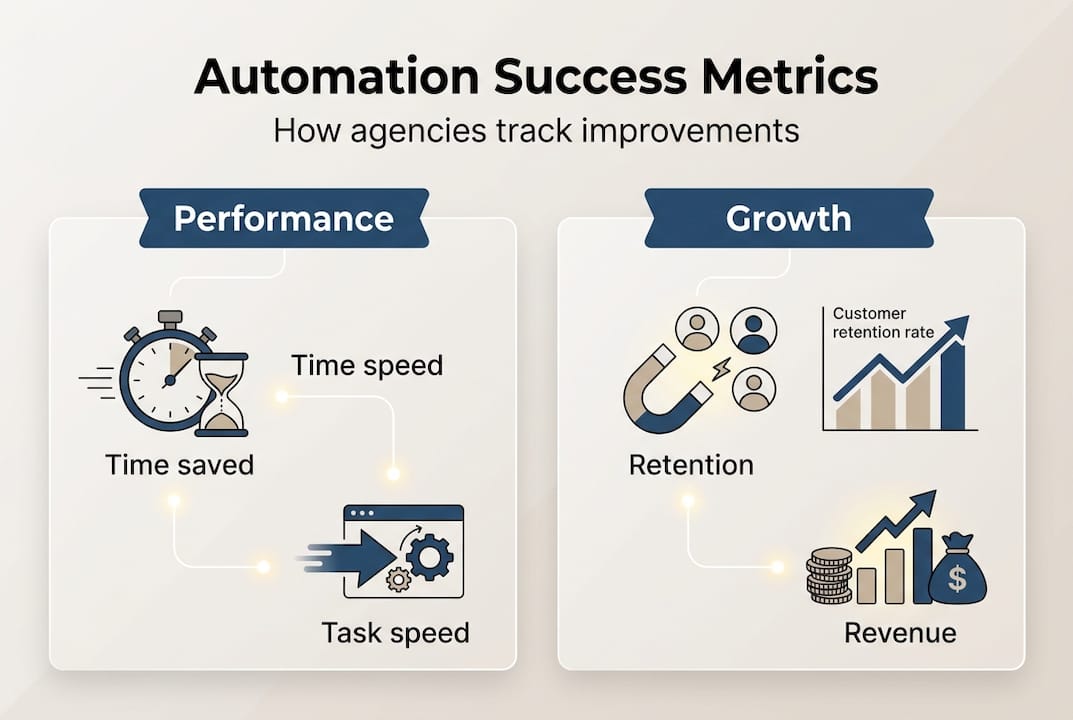
The metrics that matter most are time saved per client per week, client retention rate changes, campaign turnaround speed, and direct revenue growth attributable to freed capacity. These are the numbers that tell you whether automation is actually working or just running.
Monitoring for drift and errors is equally important. Edge cases cause 80% of failures if left unhandled, which means observability is not optional. Every automation should have error logging, alert triggers for failures, and a regular review cadence.
Optimization practices that consistently improve results include:
- Reviewing exception logs weekly and addressing recurring failure patterns
- A/B testing automation variants to identify which logic paths perform better
- Interviewing team members who interact with automated outputs to surface friction
- Tracking automation-related churn separately to isolate its effect on retention
- Scheduling quarterly audits to retire outdated automations and update integrations
“Observe, iterate, and never automate a broken process. The agencies that treat automation as a living system, not a one-time project, are the ones that compound their gains over time.”
For practical guidance on continuous improvement, top automation tips covers the optimization habits that high-performing agencies build into their workflows. A broader view of automation with AI agents shows how the next layer of intelligence can be layered onto existing automation foundations.
Our perspective: What most agencies get wrong about automation
Automation success is not primarily a technology problem. It is a process maturity and change management problem. Most agencies we see focus intensely on tool selection and spend almost no time on whether their underlying processes are actually ready to be automated. The result is fast deployment of slow, inconsistent systems.
Edge cases are where real-world automation breaks down. Agencies build for the happy path and then discover that 20% of their client scenarios do not fit the standard flow. Those exceptions pile up, erode trust in the system, and eventually push teams back to manual work.
ROI measurement is another blind spot. Many agencies measure tool cost against time saved and call it done. The real ROI lives in client retention, account expansion, and the capacity to take on new business without hiring. Tracking AI personalization strategies alongside automation outcomes reveals a fuller picture of what efficiency actually produces.
Finally, change management is consistently underestimated. Automation changes how people work, and teams that feel excluded from the process will find ways to work around it. Involve your team early, explain the why, and make the transition feel like progress rather than displacement.
Ready to scale with smart automation?
If you’re looking to skip the learning curve, experienced partners can shortcut your path to automation success.
SimplyAI works directly with agencies to design and implement automation systems that produce measurable results from day one. Whether you need AI automations for agencies that handle reporting and lead routing, or more advanced AI agents for agencies that make decisions autonomously across complex workflows, the approach is always grounded in your specific processes and goals.
The agencies scaling fastest right now are not doing it alone. They are partnering with teams that have already solved the problems they are about to face. If you want to see what that looks like for your agency, learn more from SimplyAI and take the first step toward a more efficient, scalable operation.
Frequently asked questions
What processes should agencies automate first?
Start with repetitive, low-complexity, and high-impact tasks. Pilot quick wins first such as reporting, lead routing, and campaign scheduling before tackling complex multi-system workflows.
How do you measure ROI on agency process automation?
Measure time saved per client, retention rate changes, campaign turnaround speed, and revenue growth. Empirical benchmarks show 100%+ revenue growth and 50%+ cycle time reduction as realistic outcomes from well-implemented automations.
Which automation tools are best for small agencies?
No-code tools like Zapier and Gumloop suit fast pilots, while n8n is ideal for control and cost at scale. Best tools for agencies include Zapier, n8n, Gumloop, and Simular Pro depending on complexity and budget.
What are common pitfalls in agency automation?
Skipping process mapping, automating broken flows, and neglecting exception handling lead to most failures. Edge cases cause 80% of automation failures when left unmanaged, making observability and exception logging non-negotiable from the start.