Small businesses face a paradox: AI automation promises efficiency gains and better customer experiences, yet AI adoption by small and medium-sized enterprises lags behind larger firms. Many SMB owners struggle to evaluate which automation tools deliver real value versus empty marketing claims. Understanding specific benefit criteria helps you cut through the noise and select solutions that transform operations, boost revenue, and enhance customer satisfaction. This guide presents a framework for evaluating AI automation benefits across operational efficiency, customer experience, and risk management to help you make profitable decisions for your business.
Table of Contents
- How To Evaluate AI Automation Benefits For Your SMB
- Top AI Automation Benefits For SMB Operations
- Enhancing Customer Experience With AI Automation
- Mitigating Risks And Organizational Challenges With AI Automation
- Unlock AI Automation To Transform Your Business With SimplyAI
- FAQ
Key takeaways
| Point | Details |
|---|---|
| Evaluation criteria matter | Focus on ROI, integration ease, scalability, and governance to select effective AI automation tools. |
| Operations transform | Automation reduces manual workflows and errors while recovering lost revenue from process gaps. |
| Customer experience improves | AI-driven personalization and reliability increase satisfaction, loyalty, and repeat business. |
| Risk management is critical | Governance frameworks and human oversight prevent costly mistakes and systemic failures. |
| Organizational readiness counts | Success depends on aligning technology capabilities with your team’s adoption capacity. |
How to evaluate AI automation benefits for your SMB
Selecting the right AI automation solution requires a systematic approach that matches technology capabilities to your specific business needs. Start by identifying operational bottlenecks that drain time and resources. Which manual processes create delays? Where do errors cost you money or customers? These pain points become your priority targets for automation.
Your evaluation framework should include four core criteria. First, calculate potential ROI by estimating time savings, error reduction, and revenue recovery. Second, assess integration complexity with your existing systems and workflows. Third, evaluate scalability to ensure the solution grows with your business. Fourth, examine governance safeguards that prevent unchecked errors and maintain quality control.
Consider both technical features and organizational readiness. The most powerful automation tools fail without proper training, clear processes, and team buy-in. Your staff needs to understand how AI fits into their workflows and why it benefits them personally. How to use AI in business practical guide 2026 provides actionable frameworks for building this foundation.
Key evaluation questions include:
- Does this automation solve a specific, measurable problem?
- Can we implement it without disrupting current operations?
- Will our team adopt it willingly or resist the change?
- What monitoring systems ensure quality and catch errors?
- How quickly can we scale or adjust the automation?
Pro Tip: Start with one high-impact, low-complexity process to build confidence and demonstrate value before expanding to more complex automations.
Top AI automation benefits for SMB operations
AI automation delivers tangible operational improvements that directly impact your bottom line. Despite clear benefits, 73% of small businesses still rely on manual processes for at least three core operations, leaving significant efficiency gains on the table.
Workflow automation eliminates repetitive tasks that consume staff time without adding strategic value. Invoice processing, data entry, appointment scheduling, and inventory tracking become automated, freeing your team for customer-facing activities and business development. Error rates drop dramatically because AI systems maintain consistency that human workers cannot match during high-volume periods.
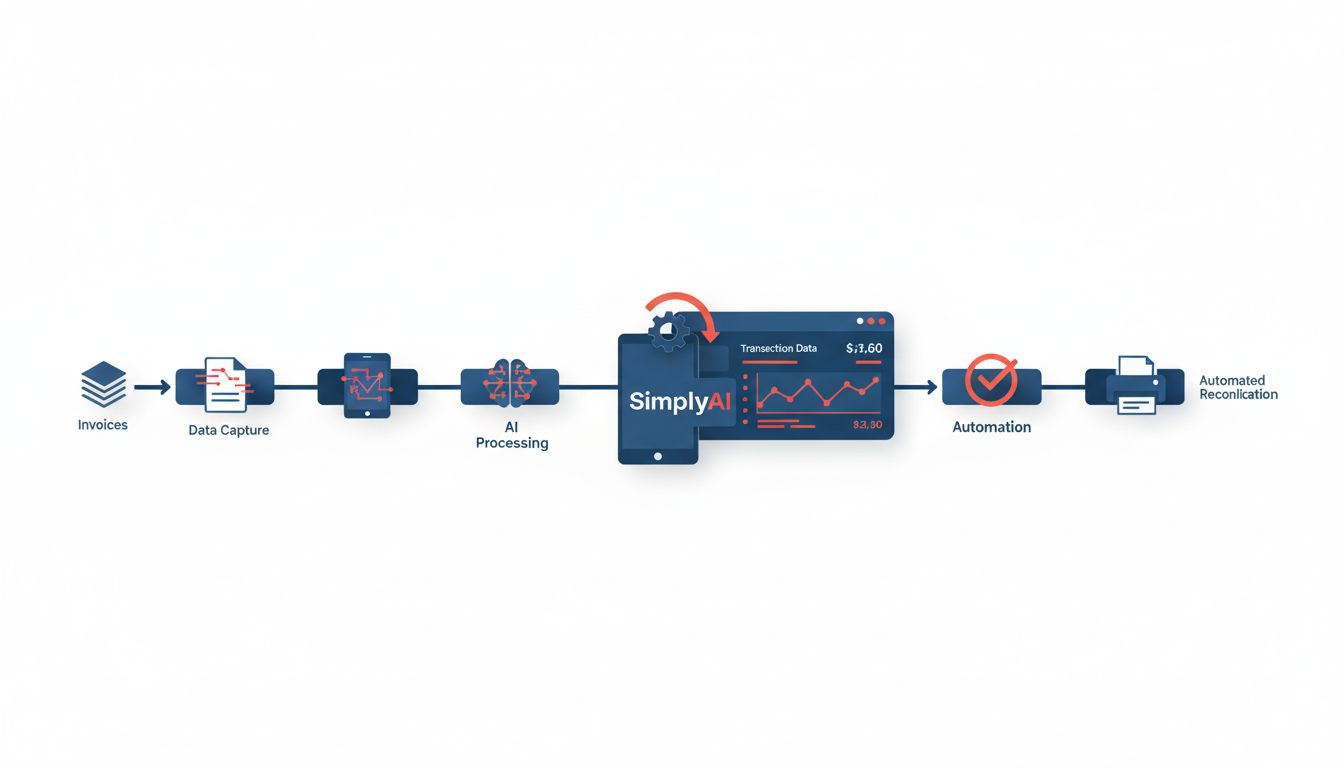
AI-driven workflow templates enable rapid deployment across multiple processes. Once you configure an automation for one task, you can replicate and adapt it for similar workflows without starting from scratch. This scalability transforms how quickly you can optimize operations and respond to changing business needs.
Revenue recovery represents a hidden operational benefit. Automated reminders reduce no-shows for appointments and meetings. Rebooking systems immediately offer alternative times when cancellations occur, filling schedule gaps that otherwise represent lost revenue. These automated touchpoints maintain customer engagement without requiring staff intervention.
The SimplyAI blog showcases real-world examples of SMBs achieving 40-60% time savings on administrative tasks through targeted automation. These hours translate directly into capacity for growth activities like customer acquisition and product development.
Practical operational benefits include:
- Reduced labor costs for routine administrative tasks
- Lower error rates in data processing and customer communications
- Faster response times to customer inquiries and requests
- Improved resource allocation by freeing staff for strategic work
- Enhanced operational visibility through automated reporting and analytics
Pro Tip: Track baseline metrics before implementing automation so you can quantify improvements and demonstrate ROI to stakeholders.
Enhancing customer experience with AI automation
Customer experience improvements often deliver the highest ROI from AI automation because they directly influence retention and referrals. Automated customer communications create consistent touchpoints that keep your business top of mind without overwhelming your team.
Personalization at scale becomes possible through AI systems that track customer preferences, purchase history, and interaction patterns. Each customer receives tailored recommendations and communications that feel individual rather than mass-market. This relevance increases engagement rates and conversion without requiring manual customization for each interaction.
Automated reminders and rebooking recover 60-70% of lost revenue from no-shows by proactively managing schedules and maintaining customer commitment. These systems send timely reminders through preferred channels, offer easy rescheduling options, and immediately fill cancellation slots with waitlisted customers.
Reliability builds trust and loyalty. When customers receive consistent, accurate responses regardless of when they contact you, they develop confidence in your business. AI chatbots and automated support systems provide 24/7 availability without requiring round-the-clock staffing, meeting customer expectations for immediate assistance.
The SimplyAI blog documents case studies where SMBs increased customer satisfaction scores by 25-35% through strategic automation of key touchpoints. These improvements translate into higher retention rates, more referrals, and increased lifetime customer value.
Customer experience benefits include:
- Faster response times to inquiries and support requests
- Personalized product recommendations based on behavior patterns
- Proactive communication about order status and relevant updates
- Seamless omnichannel experiences across web, mobile, and in-person interactions
- Consistent service quality regardless of staff availability or workload
Pro Tip: Survey customers before and after automation implementation to measure satisfaction changes and identify areas for refinement.
Mitigating risks and organizational challenges with AI automation
AI automation introduces risks that extend beyond technical failures. AI automation in SMBs fails when leaders focus on tools instead of governance, creating systemic issues that compound over time without proper oversight.
Organizational risks often exceed technical ones. Unchecked errors multiply when automated systems operate without validation checkpoints. A pricing error in an automated quote system can generate hundreds of incorrect proposals before anyone notices. A misconfigured email automation can damage customer relationships at scale.
Effective governance requires multiple layers. First, establish clear approval workflows for automation changes. Second, implement monitoring dashboards that flag anomalies in real-time. Third, maintain human oversight at critical decision points. Fourth, create feedback loops where staff and customers can report issues quickly.
The comparison between managed and unmanaged automation reveals stark differences:
| Aspect | Unmanaged Automation | Well-Managed Automation |
|---|---|---|
| Error detection | Errors compound unnoticed | Real-time alerts catch issues early |
| Quality control | Inconsistent outputs | Validation checkpoints ensure accuracy |
| Adaptation | Rigid processes resist change | Flexible frameworks adjust to needs |
| Staff confidence | Team fears automation | Team trusts and embraces automation |
| Customer impact | Negative experiences scale | Positive experiences scale |
Building an AI-first organization requires cultural shifts alongside technical implementation. Your team needs training not just on how to use automation tools, but on how to think critically about automated outputs and when to intervene.
Risk mitigation strategies include starting small with pilot projects, establishing clear success metrics, maintaining human review for high-stakes decisions, and creating escalation paths when automation encounters edge cases it cannot handle.
Pro Tip: Schedule monthly automation audits to review performance metrics, error logs, and customer feedback to catch drift before it becomes problematic.
Unlock AI automation to transform your business with SimplyAI
Translating these insights into action requires expertise in both AI technology and SMB operations. SimplyAI specializes in helping small and medium businesses implement AI automations that deliver measurable results without overwhelming your team or budget.
Our AI agents handle customer interactions, workflow management, and data processing with the governance frameworks discussed throughout this guide. We design solutions that fit your specific processes rather than forcing you to adapt to generic tools. Implementation includes comprehensive training and ongoing support to ensure your team adopts automation confidently.
Through AI corporate education, we build organizational readiness alongside technical capabilities. Your staff learns to work effectively with AI systems, identify improvement opportunities, and maintain quality control. This holistic approach prevents the common pitfalls that cause automation projects to fail despite sound technology.
SimplyAI helps you navigate the evaluation criteria covered in this guide, prioritize high-impact automations, and scale benefits safely. Our tailored approach means you get solutions designed for your industry, size, and growth trajectory rather than one-size-fits-all packages.
FAQ
What are the main benefits of AI automation for small businesses?
AI automation delivers efficient operations through reduced manual work, lower error rates, and faster processing times. Small businesses gain improved customer engagement via personalized communications and 24/7 availability. Cost savings come from labor reduction on routine tasks and revenue recovery from automated reminders and rebooking. Automation enables scaling without proportional headcount increases, allowing growth within existing resource constraints.
How can SMBs avoid risks when implementing AI automation?
Focus on governance frameworks and monitoring systems rather than just selecting tools. Establish validation checkpoints, approval workflows, and real-time anomaly detection to catch errors early. Ensure human oversight at critical decision points and create clear escalation paths for edge cases. Building an AI-first organization provides detailed strategies for balancing automation benefits with proper risk management.
What does successful AI automation adoption look like for SMBs?
Successful adoption shows consistent workflow improvements with measurable time savings and error reduction. You see positive ROI within 3-6 months through labor savings and revenue recovery. Customer experience metrics improve as satisfaction scores and retention rates increase. Your team deploys repeatable AI workflows rapidly across multiple processes while maintaining quality through governance frameworks. Staff embrace automation as a tool that enhances rather than threatens their roles.
How long does it take to see ROI from AI automation?
Most SMBs see initial ROI within 3-6 months for well-targeted automations. Quick wins like appointment reminders and basic chatbots deliver value within weeks. More complex workflow automations require 2-3 months for implementation and optimization. The key is starting with high-impact, low-complexity processes that demonstrate value quickly, then expanding to more sophisticated automations. Track baseline metrics before implementation to quantify improvements accurately and adjust strategies based on actual performance data.