
TL;DR:
- SMBs can achieve 20-30% efficiency gains using AI for data analysis.
- AI tools complement human judgment but do not replace human analysts.
- Starting with focused, no-code AI platforms helps SMBs build confidence and ROI.
Most small and medium-sized business owners are sitting on a goldmine of data they cannot fully use. Spreadsheets pile up, customer records go unanalyzed, and operational inefficiencies quietly drain revenue. Yet 58% of SMEs already use at least one AI tool to improve their analysis, signaling that the technology is no longer reserved for large enterprises. The real question is not whether AI belongs in your business, but how to use it strategically. This guide breaks down the core AI techniques, practical applications, common pitfalls, and actionable steps that help SMBs turn raw data into confident, faster decisions.
Table of Contents
- How AI transforms data analysis for SMBs
- Popular AI techniques in data analysis explained
- Tackling challenges: barriers and limitations for SMBs
- Getting the most out of AI: best practices for SMB data analysis
- Why AI augments, not replaces, business data analysis
- Give your business an AI advantage
- Frequently asked questions
Key Takeaways
| Point | Details |
|---|---|
| AI boosts SME efficiency | AI adoption in SMBs can lead to 20–30% operational improvements and cost reductions. |
| Best used for augmentation | AI excels at automating routine data analysis but needs human judgment for strategic decisions. |
| Start small for big impact | Begin with SaaS AI tools focused on one business area to minimize barriers and quickly realize value. |
| Data quality is critical | High-quality, relevant data and human oversight are essential to avoiding common AI errors. |
How AI transforms data analysis for SMBs
AI is not a single tool. It is a collection of technologies that work together to process, interpret, and act on data faster than any human team could manage alone. For SMBs, the three most relevant categories are machine learning (algorithms that learn patterns from historical data), natural language processing or NLP (which lets systems understand and generate human language), and automation (which handles repetitive analytical tasks without manual input).
These technologies open up a range of practical applications. Demand forecasting uses historical sales data to predict future inventory needs. Lead scoring ranks prospects by their likelihood to convert, saving your sales team hours of guesswork. Customer insight tools segment your audience by behavior, spending patterns, and preferences. Anomaly detection flags unusual transactions or operational irregularities before they become costly problems. Each of these was once the exclusive domain of companies with large data science teams. Now, accessible platforms bring them within reach of any motivated SMB.
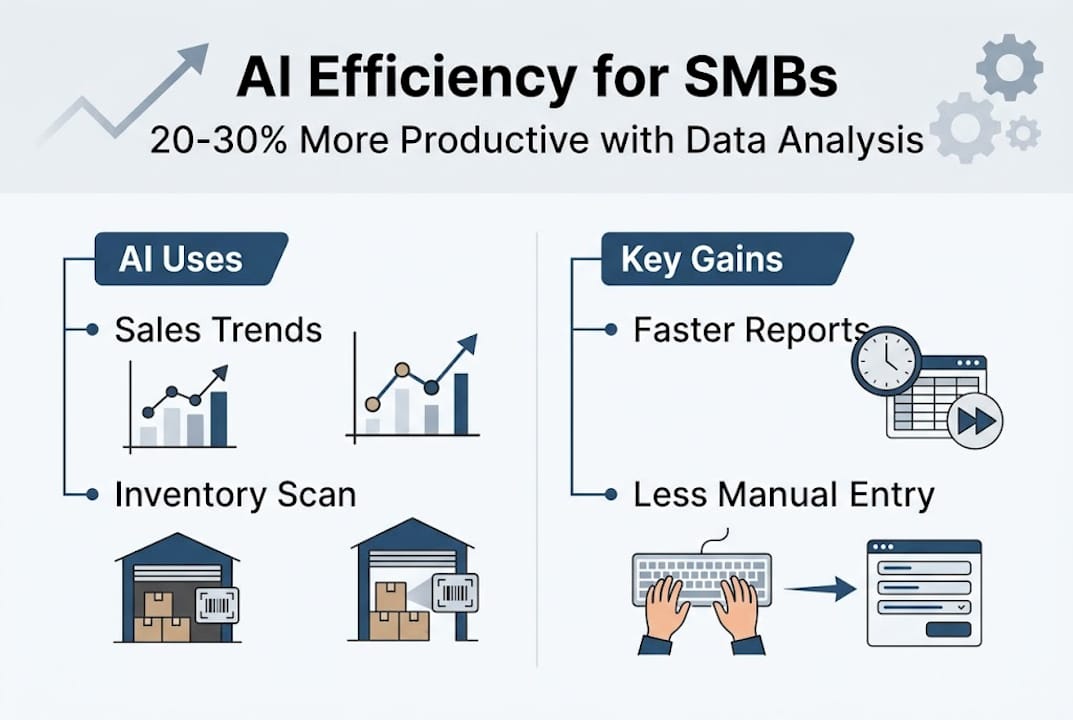
The numbers behind AI adoption are striking. AI adoption leads to 20-30% efficiency gains and up to a 30% reduction in logistics costs for businesses that implement it thoughtfully. According to SME AI adoption benchmarks, adoption rates continue to accelerate as tool costs fall and usability improves. Understanding AI for business intelligence is increasingly a competitive necessity, not a luxury.
Here is a snapshot of common AI applications and their business impact:
| AI application | Business function | Key benefit |
|---|---|---|
| Demand forecasting | Inventory management | Reduces overstock and stockouts |
| Lead scoring | Sales pipeline | Prioritizes high-value prospects |
| Customer segmentation | Marketing | Increases campaign relevance |
| Anomaly detection | Finance and operations | Catches errors and fraud early |
| Sentiment analysis | Customer service | Tracks satisfaction in real time |
Key business benefits SMBs gain from AI-powered analysis include faster reporting cycles, reduced manual data entry, more accurate forecasts, and the ability to spot trends that would otherwise go unnoticed. You can also explore data-driven automation types to see which approaches fit your current operations.

Pro Tip: If you are new to AI analytics, start with a SaaS or no-code AI platform focused on one specific task, such as sales forecasting or customer churn prediction. A single focused win builds confidence and demonstrates ROI before you scale further.
Popular AI techniques in data analysis explained
Understanding AI’s potential starts with knowing what techniques are at your disposal and where they fit. Four methods stand out as especially relevant for SMB data analysis.
Decision trees are among the most intuitive models. They map out decisions as a series of yes/no branches, making them easy to interpret and explain to non-technical stakeholders. They work well for classification tasks like identifying which customers are likely to churn.
Random forests take the decision tree concept further by building hundreds of trees simultaneously and averaging their outputs. This reduces the risk of overfitting (where a model learns noise instead of real patterns) and produces more reliable predictions across varied datasets.
Gradient boosting is a more advanced technique that builds models sequentially, with each new model correcting the errors of the previous one. It is particularly powerful for structured business data. Research on applied AI for SMEs shows that gradient boosting achieved R²=0.9914 in predictive tasks, meaning it explained over 99% of variance in the outcome variable. For demand forecasting or pricing optimization, that level of accuracy is transformative.
NLP (natural language processing) enables AI to analyze text data, such as customer reviews, support tickets, or social media comments, and extract sentiment, intent, or key themes. This gives SMBs a structured way to act on qualitative feedback at scale.
Here is a quick comparison of these techniques:
| Technique | Best for | Complexity |
|---|---|---|
| Decision tree | Customer classification, churn | Low |
| Random forest | Sales forecasting, risk scoring | Medium |
| Gradient boosting | Pricing, demand prediction | Medium-high |
| NLP | Sentiment analysis, feedback review | Medium |
A simple AI analysis workflow for SMBs follows these steps. First, collect and clean your data from CRM, sales, or operational systems. Second, choose a technique suited to your business question. Third, train the model on historical data. Fourth, validate results against known outcomes. Fifth, deploy the model and monitor its performance over time. Understanding how AI agents in the workplace fit into this workflow can help you automate the monitoring step and keep your analysis current without constant manual effort.
Tackling challenges: barriers and limitations for SMBs
While AI offers huge promise, adopting it is not without its difficulties. The most common barriers SMBs face include high initial costs, a shortage of in-house expertise, inadequate data infrastructure, and inconsistent data quality. Challenges include initial cost, expertise shortage, and poor data quality, and these obstacles are real, not just theoretical concerns.
Beyond structural barriers, there are important technical limitations to understand. AI models are only as good as the data they are trained on. If your customer records are incomplete or your sales data has gaps, the model will produce unreliable outputs. Overfitting is another common failure, where a model performs well on training data but poorly in real-world conditions. And edge cases, situations the model was never trained to handle, remain a persistent weakness.
“AI may hallucinate or produce incorrect outputs in up to 79% of complex reasoning tasks, making human oversight non-negotiable in high-stakes decisions.”
The AI benchmarks for SMEs literature consistently shows that most AI failures stem from unforeseen scenarios rather than fundamental flaws in the technology itself. This is a critical insight. The technology is not broken; the implementation is often rushed or under-resourced.
Practical steps to reduce risk include improving data quality before deploying any model, starting with lower-stakes use cases to build organizational familiarity, and maintaining human review of all AI-generated outputs. Exploring AI automation for entrepreneurs can help you identify which tasks are safe to automate immediately and which require more careful oversight. The goal is not to hand over your analysis to a machine. It is to use AI as a powerful assistant that accelerates your work while you retain final judgment.
Getting the most out of AI: best practices for SMB data analysis
To maximize value and avoid common pitfalls, here is how you can thoughtfully implement AI in your business. The key is a staged, deliberate approach rather than a sweeping overhaul.
Follow these steps to build a sustainable AI analytics practice:
- Audit your data first. Identify what data you have, where it lives, and how clean it is. AI cannot fix bad data; it amplifies it.
- Define one clear business question. Start with a specific problem, such as “Which customers are most likely to stop buying from us in the next 90 days?”
- Choose the right tool for the task. Match the technique to the question. Do not use a complex model when a simple one will do.
- Pilot on a small dataset. Test your model on a subset of data before rolling it out company-wide.
- Establish human review checkpoints. Assign a team member to review AI outputs regularly, especially in the early stages.
- Measure and iterate. Track whether the AI’s recommendations actually improve outcomes, and adjust accordingly.
AI augments routine tasks but delivers the best results when combined with human judgment, particularly for decisions involving context, relationships, or ethical considerations. This is not a weakness of AI. It is simply how the technology works best in practice.
Cross-functional adoption matters too. When your marketing, operations, and finance teams all understand what AI can and cannot do, they use it more effectively and catch errors more reliably. A step-by-step AI integration guide can help you structure this rollout across departments. And if you are thinking longer term, building an AI-first organization requires embedding these practices into your culture, not just your tech stack.
Pro Tip: Focus your first AI investment on a SaaS tool that handles a routine, high-volume task, such as invoice categorization or email response prioritization. These tools typically deliver ROI within weeks and build team confidence for more ambitious projects.
Why AI augments, not replaces, business data analysis
There is a persistent narrative that AI will eventually make human analysts obsolete. The evidence does not support this view, at least not in the near term and not for SMBs. AI reshapes work by excelling at automating routine tasks, but it still requires human input for context-sensitive insights and strategic judgment.
The uncomfortable truth is this: AI is only as strong as the data you feed it, the questions you ask it, and the oversight you apply to its outputs. Business owners who treat AI as an infallible oracle will be disappointed. Those who treat it as a capable collaborator, one that handles volume and pattern recognition while they focus on interpretation and strategy, will see dramatic results.
At SimplyAI, we see this dynamic play out consistently. The businesses that gain the most from AI automation for entrepreneurs are not the ones that automate everything. They are the ones that identify precisely where AI removes friction and then apply human expertise where it counts most. That balance is the real competitive advantage.
Give your business an AI advantage
For SMBs ready to put these insights into action, specialized tools and expert support can accelerate your journey significantly.
At SimplyAI, we help small and medium-sized businesses implement AI automation services and deploy AI agents for SMBs that deliver measurable results from day one. Whether you need to automate your reporting pipeline, build a customer segmentation model, or train your team through our AI corporate education program, we design solutions that fit your actual operations, not a generic template. The gap between knowing what AI can do and actually making it work for your business is where we come in.
Frequently asked questions
What are the tangible benefits of using AI for data analysis in SMBs?
AI adoption leads to substantial efficiency gains of 20-30% and logistics cost reductions of up to 30%, along with faster and more accurate business insights that support better decision-making.
Does AI in data analysis replace the need for human analysts?
No. AI augments analytical work by automating repetitive tasks, but humans remain essential for complex decisions, contextual interpretation, and managing edge cases the model was not trained on.
What is the easiest way for small businesses to start with AI data analysis?
Begin with a SaaS or no-code AI tool focused on one specific task, such as sales forecasting or lead scoring. SMBs can quickly gain ROI with focused tools before scaling to more complex integrations.
What are the main risks of relying on AI for business data analysis?
The most common risks are poor data quality, overfitting, edge-case errors, and misinterpreting AI outputs without human review. AI failure often results from edge cases and insufficient oversight rather than fundamental technology flaws.