
Many small business owners assume AI is a set-it-and-forget-it technology. You install a chatbot, automate a workflow, and expect it to perform consistently forever. That’s how traditional AI works, but it’s not the full story. Adaptive AI changes the game by continuously learning from real-time data and user behavior, evolving to meet shifting business conditions. For SMBs looking to maximize automation effectiveness and operational efficiency, understanding adaptive AI is no longer optional. It’s the difference between static tools and intelligent systems that grow smarter with your business.
Table of Contents
- What Is Adaptive AI And How Does It Differ From Traditional AI?
- Core Techniques Powering Adaptive AI
- Benefits Of Adaptive AI For Small And Medium-Sized Businesses
- Challenges And Best Practices In Implementing Adaptive AI
- Unlock Adaptive AI Superpowers For Your Business
- Frequently Asked Questions
Key takeaways
| Point | Details |
|---|---|
| Adaptive AI learns continuously | Unlike traditional AI, it updates its knowledge base in real-time based on new data and changing conditions. |
| Core techniques drive adaptation | Reinforcement learning, continual learning, and world models enable ongoing improvement without forgetting past knowledge. |
| SMBs see measurable gains | Productivity boosts of 30-45% and revenue increases of 20-27% are common with adaptive AI automation. |
| Challenges exist but are manageable | Issues like catastrophic forgetting and learning instability can be mitigated with hybrid models and constrained approaches. |
| Hybrid models balance speed and planning | Combining reactive and deliberative AI agent architectures delivers both quick responses and strategic decision-making. |
What is adaptive AI and how does it differ from traditional AI?
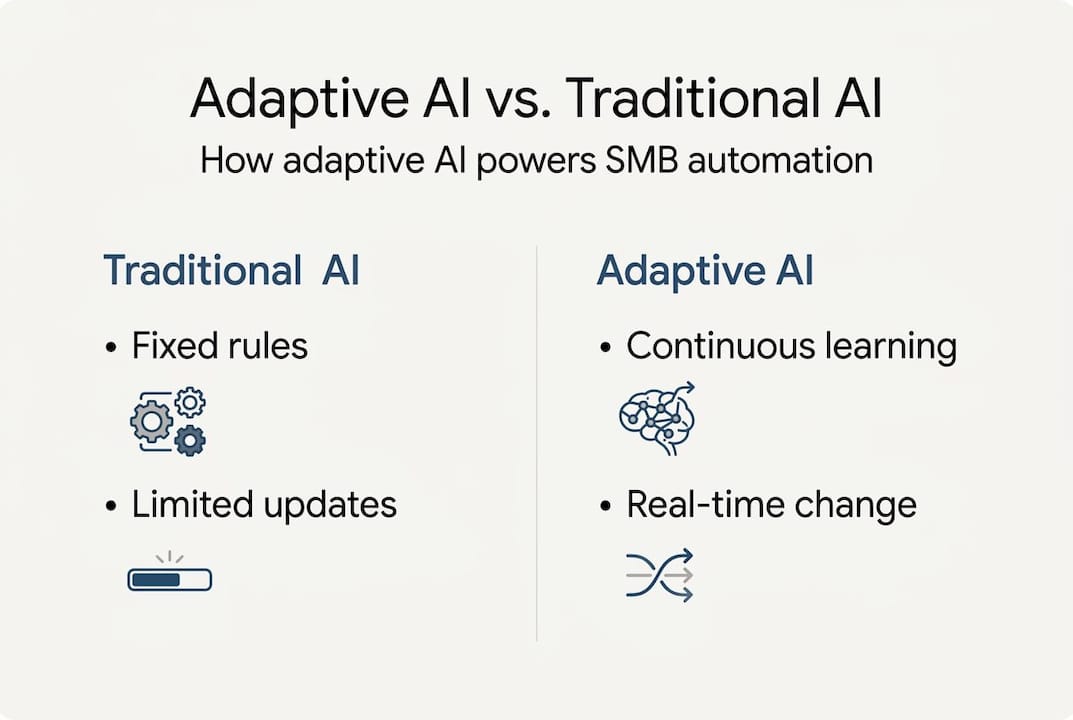
Adaptive AI refers to AI systems that dynamically learn, evolve, and adjust in real-time to changing data, environments, user behaviors, or conditions. Traditional AI models are trained once on a fixed dataset, then deployed to perform the same tasks repeatedly. They don’t update themselves when customer preferences shift, market conditions change, or new patterns emerge. You get what you trained, and that’s it.
Adaptive AI flips this model. It continuously updates its knowledge base, refining predictions and actions based on fresh inputs. If your customer service chatbot encounters a new type of question, adaptive AI learns from the interaction and improves future responses. If your inventory system detects a sudden demand spike, it adjusts ordering patterns without waiting for manual recalibration. This ongoing evolution makes adaptive AI far more resilient and relevant over time.
The core mechanics include continuous and reinforcement learning and dynamic adjustments without forgetting prior knowledge. Here’s what sets adaptive AI apart:
- Traditional AI relies on static training data and fixed algorithms
- Adaptive AI ingests new data streams and updates models on the fly
- Reinforcement learning allows the system to improve through trial and error
- Continual learning prevents the AI from forgetting earlier lessons as it adapts
- Dynamic model adjustments respond to distribution shifts in real-world conditions
For SMBs, this means your AI automation doesn’t become outdated six months after deployment. It grows with your business, learning from customer interactions, seasonal trends, and operational changes. You’re not locked into a rigid system that requires expensive retraining every time something shifts. Adaptive AI handles the evolution for you, keeping your automation relevant and effective without constant manual intervention.
Core techniques powering adaptive AI
Adaptive AI isn’t magic. It’s built on sophisticated techniques borrowed from neuroscience and machine learning research. Understanding these methods helps you appreciate why adaptive systems outperform static ones and how they maintain performance over time.
Reinforcement learning (RL) is the engine of trial-and-error improvement. The AI receives feedback on its actions, positive or negative, and adjusts its behavior to maximize rewards. Think of a customer service agent learning which responses resolve issues fastest. Over time, it discovers optimal strategies through experimentation, not just following pre-programmed scripts. RL enables adaptive AI to tackle complex, dynamic problems where the best solution isn’t obvious upfront.
Continual learning prevents the dreaded catastrophic forgetting problem. When traditional AI learns something new, it often overwrites old knowledge, losing valuable skills it previously mastered. Continual learning techniques allow the system to integrate fresh information while retaining prior expertise. Your AI agent can learn to handle new product lines without forgetting how to process returns for existing inventory. This balance is crucial for SMBs operating in evolving markets.
Core mechanics include world models from neuroscience, which simulate environments to predict outcomes before taking action. Instead of reacting blindly, the AI builds an internal representation of how your business operates. It can forecast what happens if it recommends a specific upsell, adjusts pricing, or routes a customer inquiry to a particular team member. This predictive capability reduces costly mistakes and accelerates learning.
Dynamic model adjustments improve responsiveness to real-world shifts. If your customer demographics change, adaptive AI detects the pattern and recalibrates its models accordingly. You don’t need to manually retrain the system every quarter. The AI monitors performance metrics, identifies drift, and updates itself to maintain accuracy. For example, an AI agent managing email campaigns might notice declining open rates and automatically test new subject line strategies, learning which variations resonate with your current audience.
Pro Tip: Integrate your adaptive AI with a centralized intelligence layer to coordinate learning across multiple business functions. When your sales AI discovers a new customer objection pattern, that insight can inform your support chatbot and marketing automation simultaneously, amplifying the value of every adaptation.
The neuroscience connection runs deep. Researchers draw inspiration from how biological brains learn and adapt, applying those principles to artificial systems. Neuroscience AI research explores memory consolidation, attention mechanisms, and hierarchical learning structures that mirror human cognition. This cross-pollination drives breakthroughs in adaptive AI, making systems more robust and capable of handling the messy, unpredictable nature of real business environments. As you consider AI solutions, remember that the most advanced systems leverage these brain-inspired techniques to deliver truly intelligent automation. Addressing the AI corporate education gap in your organization helps your team understand and leverage these powerful capabilities effectively.
Benefits of adaptive AI for small and medium-sized businesses
Adaptive AI delivers tangible, measurable improvements for SMBs willing to embrace it. The data speaks clearly. SMBs using adaptive AI see productivity gains of 30-45%, revenue growth of 20-27%, and cost savings exceeding $5,000 monthly. These aren’t hypothetical projections. They’re real outcomes from businesses that deployed adaptive automation and tracked results.
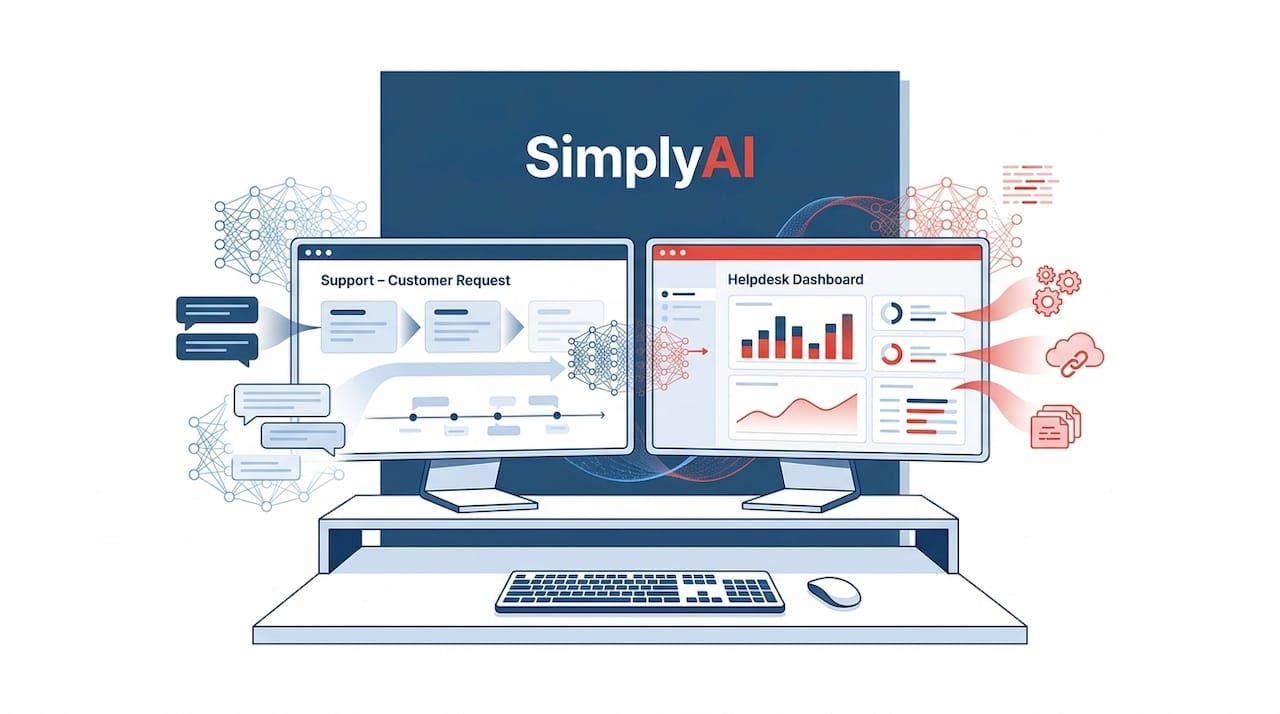
Customer service transforms when adaptive AI powers your chatbots and support systems. Traditional bots follow rigid scripts, frustrating customers with irrelevant responses. Adaptive AI learns from every conversation, recognizing new question types and improving answer quality over time. If customers start asking about a product feature you recently launched, the AI picks up the pattern and provides accurate information without you manually updating a knowledge base. Response times drop, customer satisfaction climbs, and your support team focuses on complex issues instead of repetitive inquiries.
Inventory management becomes predictive rather than reactive. Adaptive AI analyzes sales trends, seasonal patterns, supplier lead times, and external factors like weather or local events. It adjusts reorder points dynamically, preventing stockouts during unexpected demand spikes and reducing excess inventory during slow periods. One SMB retailer cut carrying costs by 22% while improving product availability by 18% after implementing adaptive inventory AI. The system learned their unique business rhythm and optimized accordingly.
Marketing automation reaches new levels of personalization. Adaptive AI segments customers based on evolving behaviors, not static demographics. It tests messaging variations, learns which offers resonate with different segments, and refines targeting in real-time. Email open rates improve, conversion rates climb, and you stop wasting budget on campaigns that don’t work. The AI continuously optimizes your marketing mix, adapting to seasonal shifts and competitive pressures without constant manual tweaking.
Here’s how adaptive AI impacts key metrics across SMB sectors:
| Business Function | Productivity Gain | Cost Reduction | Revenue Impact |
|---|---|---|---|
| Customer Service | 35-42% | $3,500-$6,000/month | 15-20% increase in retention |
| Inventory Management | 28-38% | $4,200-$7,500/month | 18-25% reduction in stockouts |
| Marketing Automation | 30-45% | $2,800-$5,200/month | 20-27% lift in conversions |
| Sales Process | 32-40% | $3,000-$5,800/month | 22-28% increase in deal velocity |
Adaptive AI automation reduces the burden of repetitive tasks significantly. Your team spends less time on data entry, routine customer inquiries, and manual report generation. They focus on strategic work that requires human judgment and creativity. Employee satisfaction improves when people aren’t stuck doing boring, repetitive work that a machine can handle better.
Pro Tip: Track weekly KPIs before and after implementing adaptive AI to quantify its impact on your specific business. Monitor metrics like task completion time, error rates, customer satisfaction scores, and revenue per employee. This data justifies your AI investment and helps you identify which processes benefit most from adaptive automation. The insights also guide where to expand AI usage next, creating a virtuous cycle of continuous improvement.
The AI automation benefits compound over time. Unlike static systems that deliver initial gains then plateau, adaptive AI keeps improving. Every customer interaction, every transaction, every process execution feeds the learning loop. Your automation gets smarter month after month, delivering increasing returns on your initial investment. This compounding effect is what separates adaptive AI from traditional automation tools that require constant manual updates to maintain relevance.
Challenges and best practices in implementing adaptive AI
Adaptive AI isn’t without challenges. Understanding potential pitfalls and mitigation strategies helps you deploy these systems successfully and avoid costly mistakes.
Reactive versus deliberative AI agent models represent a fundamental design choice. Reactive agents respond immediately to stimuli, executing fast but simple behaviors. They’re great for real-time customer service or quick data processing tasks. Deliberative agents plan ahead, reasoning through complex scenarios before acting. They excel at strategic decisions like resource allocation or long-term forecasting. Most SMBs benefit from hybrid approaches that combine both models.
| Approach | Strengths | Weaknesses | Best Use Cases |
|---|---|---|---|
| Reactive | Fast response, simple implementation, low computational cost | Limited planning, can’t handle complex multi-step tasks | Customer service chatbots, real-time alerts, simple routing |
| Deliberative | Strategic planning, handles complexity, optimizes long-term outcomes | Slower response, higher computational requirements | Inventory optimization, workforce scheduling, pricing strategy |
| Hybrid | Balances speed and planning, adapts to task complexity | Requires careful architecture design | Multi-function business automation, adaptive workflows |
Challenges include RL gradient variance, catastrophic forgetting, brittleness to distribution shifts, mitigated by adaptive sampling and constrained RL. Gradient variance means learning can be unstable, with the AI making erratic updates that hurt performance before improving it. Adaptive sampling techniques smooth this process, ensuring more consistent progress. Catastrophic forgetting happens when new learning overwrites valuable old knowledge. Continual learning methods preserve prior expertise while integrating fresh information.
Brittleness to distribution shifts is a fancy way of saying the AI breaks when conditions change too much. If your customer base suddenly skews younger, or a new competitor disrupts your market, traditional AI models struggle. Adaptive AI handles these shifts better, but you still need safeguards. Constrained reinforcement learning sets boundaries on what the AI can change, preventing it from making wild, risky adjustments during turbulent periods.
Common pitfalls SMBs encounter:
- Analysis paralysis from too much deliberation, slowing decision-making
- Over-optimization for recent data, losing sight of long-term patterns
- Insufficient monitoring, allowing the AI to drift without detection
- Poor data quality feeding the learning loop, amplifying errors
- Lack of human oversight on critical business decisions
Pro Tip: Implement hybrid reactive-deliberative agents and constrained RL to balance safety and learning. Set clear boundaries on what your AI can adjust autonomously versus what requires human approval. For example, let it optimize email send times freely, but flag pricing changes above 10% for your review. This approach captures adaptive AI’s benefits while protecting against runaway optimization or unexpected behavior.
Continuous monitoring is not optional with adaptive AI. The system learns and evolves, which means its behavior changes over time. Weekly performance reviews catch drift early, before it impacts customer experience or business outcomes. Track key metrics, review edge cases, and maintain feedback loops between your team and the AI. This vigilance ensures your adaptive systems remain aligned with business goals as they learn and grow.
Building an AI-first organization requires cultural shifts alongside technical implementation. Your team needs to understand how adaptive AI works, trust its recommendations while maintaining healthy skepticism, and know when to intervene. Training and change management are as important as the technology itself. SMBs that succeed with adaptive AI invest in both the systems and the people who work alongside them, creating a collaborative environment where human judgment and machine intelligence complement each other.
Unlock adaptive AI superpowers for your business
You’ve seen how adaptive AI transforms SMB automation, delivering productivity gains, cost savings, and revenue growth that static systems can’t match. The question isn’t whether adaptive AI matters for your business. It’s how quickly you can harness its power to outpace competitors still relying on rigid, outdated automation.
SimplyAI specializes in AI automations and AI agents designed specifically for SMBs like yours. We implement adaptive systems that learn from your unique business patterns, continuously improving performance without constant manual intervention. Our solutions integrate seamlessly with your existing workflows, delivering measurable results from day one while getting smarter over time. Ready to move beyond static automation? Explore how SimplyAI can design adaptive AI solutions tailored to your business goals and growth trajectory.
Frequently asked questions
What is adaptive AI?
Adaptive AI refers to artificial intelligence systems that continuously learn and adjust based on real-time data and changing conditions. Unlike traditional AI trained once and deployed statically, adaptive AI updates its models dynamically, improving performance as it encounters new patterns and user behaviors. This makes it ideal for business environments where customer preferences, market conditions, and operational demands evolve constantly.
How can adaptive AI improve my small business automation?
Adaptive AI personalizes automation to your specific business context and adjusts as conditions change. It learns from customer interactions to improve service quality, optimizes inventory based on emerging demand patterns, and refines marketing campaigns in real-time. SMBs typically see 30-45% productivity boosts and 20-27% revenue increases because the AI continuously eliminates inefficiencies and adapts to what works best for your unique situation.
What are the main challenges of using adaptive AI and how can I address them?
Key challenges include learning instability, where the AI makes erratic updates, and catastrophic forgetting, where new learning overwrites valuable old knowledge. You can mitigate these issues by using hybrid reactive-deliberative models that balance speed with strategic planning, implementing constrained reinforcement learning to set safe boundaries, and maintaining continuous monitoring to catch drift early. Regular performance reviews and human oversight on critical decisions keep adaptive AI aligned with business goals.
Is adaptive AI suitable for all small business types?
Adaptive AI works best for SMBs with dynamic, data-rich workflows like retail, customer service, inventory management, and marketing automation. Businesses with frequent customer interactions, changing demand patterns, or evolving market conditions benefit most. It’s less suited for very static environments with minimal data flow or highly regulated industries where system changes require extensive compliance review. Start by identifying which business processes generate enough data and face enough variability to justify adaptive approaches.
How do I get started with adaptive AI for my business?
Begin by identifying business needs where conditions change frequently and data is available to feed learning loops. Choose hybrid adaptive AI tools that combine reactive speed with deliberative planning capabilities. Pilot the system in one area, like customer service or email marketing, while monitoring performance metrics weekly. Adjust based on results, then expand to additional functions as you build confidence and expertise. Partner with experienced providers who understand SMB contexts and can tailor solutions to your specific industry and growth stage.