
TL;DR:
- AI-powered CRM offers SMBs active data analysis, predictive insights, and automated customer interactions.
- Success depends on quality data, incremental implementation, staff training, and organizational readiness.
- Starting small with high-impact automations builds confidence and drives scalable growth over time.
AI-powered CRM is no longer the exclusive domain of Fortune 500 companies with massive IT budgets. Small and medium-sized businesses now have access to the same customer intelligence, automation, and predictive capabilities that once required enterprise-level resources. This guide breaks down exactly what AI-powered CRM is, how it works at a technical level, and what tangible results you can realistically expect as an SMB owner. Whether you are evaluating platforms or just beginning to explore the concept, the insights here are grounded in current research and designed to help you move forward with confidence.
Table of Contents
- Defining AI-powered CRM: Core concepts explained
- How AI-powered CRM works: Data, automation, and multichannel integration
- Top benefits of AI-powered CRM for SMBs
- Implementation steps: Getting started with AI-powered CRM
- Why starting small with AI-powered CRM beats chasing big tech trends
- Unlock AI superpowers for your business
- Frequently asked questions
Key Takeaways
| Point | Details |
|---|---|
| AI-powered CRM basics | These systems use artificial intelligence to automate and personalize customer management for any size business. |
| Tangible business benefits | SMBs can boost revenue, efficiency, and customer satisfaction by leveraging AI-driven insights and automation. |
| People and data matter | Success hinges not just on AI tools but on data quality and readiness of your team. |
| Start small for success | Focus on high-impact automations first to build confidence before scaling across the business. |
Defining AI-powered CRM: Core concepts explained
A traditional CRM is essentially a structured database. It stores contact information, logs interactions, and tracks deals through a sales pipeline. Useful, yes. But largely passive. An AI-powered CRM goes several steps further by actively analyzing that data, identifying patterns, and triggering actions without waiting for a human to initiate them.
The core technologies driving this shift include machine learning (algorithms that improve predictions over time by learning from historical data), natural language processing or NLP (which allows the system to understand and generate human language, enabling chatbots and email analysis), and automation engines (rule-based or AI-driven workflows that execute tasks like follow-up emails or lead routing automatically).
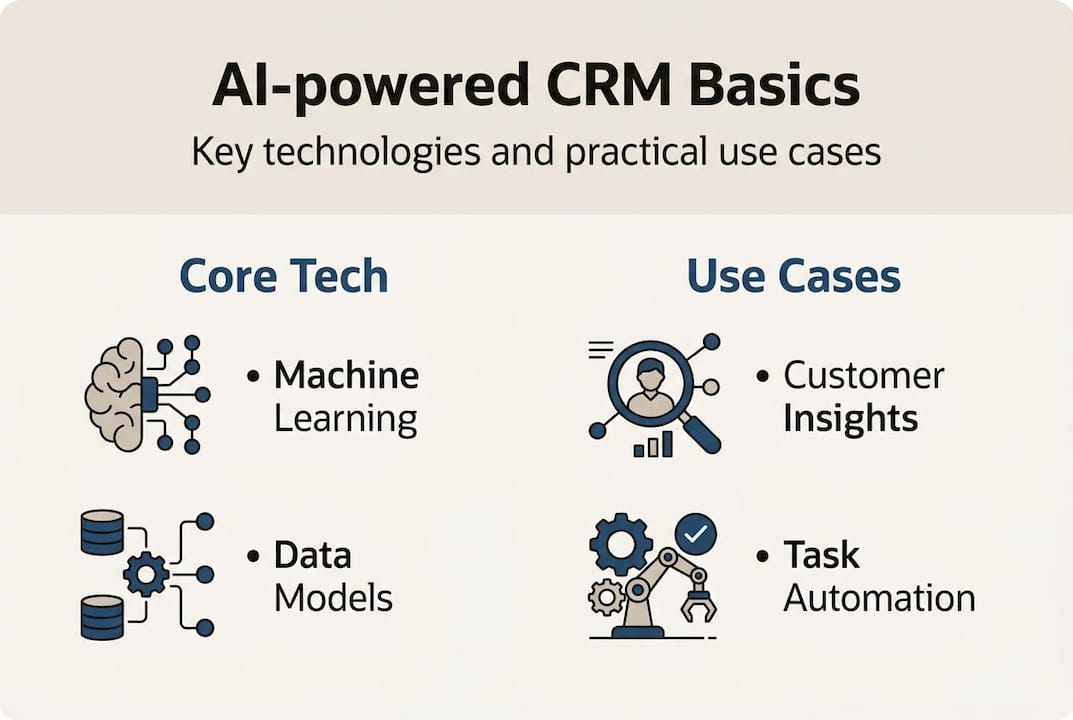
In practice, these technologies enable three transformative use cases. First, data-driven customer insights: the system surfaces patterns in buying behavior, churn risk, and engagement levels that a human analyst might miss. Second, predictive analytics: the CRM forecasts which leads are most likely to convert, or which customers are about to leave. Third, proactive communication: the system initiates outreach at optimal times based on behavioral signals, rather than waiting for a sales rep to remember.
A critical but often overlooked element is ethical design and data centralization. Research on AI-powered CRM frameworks emphasizes that effective systems are built on ethics by design, centralized data architecture, continuous model retraining, and active user involvement. Without these foundations, even the most sophisticated AI will produce unreliable or biased outputs.
Here is a quick comparison to ground the difference:
| Feature | Traditional CRM | AI-powered CRM |
|---|---|---|
| Data entry | Manual | Automated and enriched |
| Insights | Static reports | Predictive and real-time |
| Customer segmentation | Rule-based | Behavior-driven and dynamic |
| Communication | Scheduled by reps | Triggered by AI signals |
| Personalization | Template-based | Individually tailored |
For SMBs specifically, AI personalization for engagement represents one of the most accessible entry points, allowing even lean teams to deliver experiences that feel custom-built for each customer.
“An integration framework for AI-powered CRM emphasizes ethics by design, data centralization, model retraining, and user involvement as foundational pillars, with core capabilities spanning data management, multi-channel integration, and tailored services.” — Integration framework for AI-powered CRM, ScienceDirect
How AI-powered CRM works: Data, automation, and multichannel integration
Understanding the mechanics behind AI-powered CRM removes much of the mystery and helps you evaluate platforms with sharper criteria. At its core, the system works through a continuous loop: collect data, process it, generate insights, and act on them.
Here is how that loop typically unfolds in a real business environment:
- Data ingestion: Customer interactions from email, chat, social media, phone calls, and web behavior flow into a centralized data layer. This is the foundation everything else depends on.
- Data enrichment and cleaning: AI tools normalize and fill gaps in the data, flagging duplicates and inconsistencies automatically.
- Model analysis: Machine learning models analyze the enriched data to score leads, predict churn, identify upsell opportunities, and segment customers by behavior.
- Automated action: Based on model outputs, the system triggers workflows: sending a follow-up email, alerting a sales rep, routing a support ticket, or updating a deal stage.
- Feedback loop: Human interactions with those automated outputs feed back into the model, improving accuracy over time.
The multichannel integration dimension is particularly important. Customers interact with your business across multiple touchpoints, and a siloed view of any one channel produces an incomplete picture. When chat, email, phone, and social are unified in one system, the AI can build a genuinely accurate customer profile and respond intelligently across all of them.
Regular model retraining matters more than most SMB owners realize. Customer behavior shifts, seasonality changes, and product updates all affect model accuracy. A system that was well-calibrated six months ago may be producing stale predictions today without retraining.
Conversational AI for customer service is one of the most visible applications of this architecture, handling routine inquiries autonomously while escalating complex cases to human agents. Pairing this with AI automation for business growth creates a compounding effect where efficiency gains in one area free up capacity for higher-value work.
Pro Tip: Do not try to automate everything at once. Start with the single highest-volume, lowest-complexity task in your customer workflow, such as lead qualification or appointment reminders, and prove the value before scaling.
Top benefits of AI-powered CRM for SMBs
Knowing how the system works makes the benefits easier to appreciate in concrete terms. For SMBs, the gains are not abstract. They show up in daily operations, customer satisfaction scores, and revenue metrics.
The most impactful benefits include:
- Enhanced personalization: AI analyzes purchase history, browsing behavior, and communication preferences to tailor every interaction. Customers receive relevant offers and messages rather than generic blasts.
- Improved customer service: Automated support tools handle routine questions around the clock, reducing response times and freeing your team for complex cases.
- Automation of repetitive tasks: Lead scoring, data entry, follow-up scheduling, and report generation happen autonomously, returning hours to your team each week.
- Smarter decision-making: Predictive analytics surfaces which deals are most likely to close, which customers are at risk of churning, and where your pipeline has gaps.
- Scalable growth: As your customer base grows, the AI scales with it without requiring proportional headcount increases.
The productivity impact is significant. Businesses that implement AI-driven lead generation and CRM automation consistently report faster sales cycles and higher conversion rates compared to manual processes.

However, the benefits do not arrive automatically. Forrester research makes clear that success requires strong ethics and governance frameworks, a deliberate strategy of starting small with high-impact automations, and honest assessment of whether your people and data are ready. Agentic AI, where the system takes multi-step autonomous actions, is technically mature but often outpaces organizational readiness.
For SMBs exploring AI in document processing, integrating that capability with CRM data creates a particularly powerful combination for automating contract management and customer onboarding workflows.
Key stat: Companies that prioritize data and people readiness alongside AI deployment see dramatically better adoption rates and faster return on investment than those that focus solely on platform selection.
Implementation steps: Getting started with AI-powered CRM
With the benefits clear, the practical question becomes: how do you actually get started without overwhelming your team or wasting budget on the wrong platform? The answer is a structured, phased approach.
- Assess your current state: Map your existing customer data sources, identify gaps, and document the manual processes that consume the most time. This audit becomes your implementation roadmap.
- Prepare your data: Clean your existing CRM or contact data before migrating it. Remove duplicates, standardize formats, and fill critical missing fields. Dirty data fed into an AI system produces unreliable outputs.
- Choose the right platform: Evaluate platforms based on your specific use cases, not feature lists. Prioritize ease of integration with your existing tools, quality of vendor support, and transparency in how the AI makes decisions.
- Pilot with one high-impact automation: Select a single workflow, such as automated lead scoring or post-purchase follow-up sequences, and run a controlled pilot. Measure results rigorously before expanding.
- Train your staff: Technology adoption fails most often at the human layer. Invest in training that helps your team understand what the AI does, why it makes certain recommendations, and how to act on its outputs.
- Iterate and expand: Use feedback from your pilot to refine the model and workflows, then systematically add automations based on proven ROI.
Forrester’s analysis consistently highlights that starting small and focusing on readiness of both people and data is what separates successful AI deployments from expensive experiments. Understanding what AI agents are and how adaptive AI evolves over time will help you plan for the next phase of your implementation.
Pro Tip: Invest in data quality before you invest in AI features. A well-structured, clean dataset running on a mid-tier platform will outperform messy data on the most advanced system available.
Why starting small with AI-powered CRM beats chasing big tech trends
There is a persistent temptation in the SMB market to equate sophistication with scale. The assumption is that buying the most feature-rich platform signals commitment to AI transformation. In practice, the opposite is often true.
The businesses that see the strongest results from AI-powered CRM are not the ones who deployed the most tools at once. They are the ones who identified one or two genuinely painful bottlenecks, automated those specifically, measured the outcome, and built from there. This iterative model creates organizational confidence, generates real data on what works, and builds the internal expertise needed for more complex deployments later.
Forrester’s findings reinforce this clearly: agentic AI is technically ready, but organizational readiness in data and people remains the limiting factor. Chasing the most advanced capabilities before your team understands the basics is a reliable path to low adoption and wasted investment.
Focusing on business growth with automation through targeted, high-impact wins creates momentum that a big-bang deployment rarely achieves. Small, fast wins are not a compromise. They are the strategy.
Unlock AI superpowers for your business
If this guide has clarified what AI-powered CRM can do for your business, the next step is putting that knowledge into action with the right support behind you.
At SimplyAI.gr, we specialize in helping SMBs design and implement AI systems that deliver real, measurable results without the complexity or cost typically associated with enterprise deployments. From AI automation services and AI agents that handle customer interactions autonomously, to AI corporate education that prepares your team to work confidently alongside intelligent systems, we offer practical pathways tailored to where your business is today and where you want it to go.
Frequently asked questions
What is an AI-powered CRM in simple terms?
An AI-powered CRM is a customer relationship management system enhanced with artificial intelligence to automate tasks, analyze data, and provide personalized insights. Unlike traditional CRMs, it actively learns from customer data to improve recommendations over time.
How does AI-powered CRM help small businesses?
It helps small businesses automate repetitive tasks, improve customer interactions, and unlock smarter sales and support through actionable data. Starting with focused automations and strong governance practices accelerates the return on investment.
What is an example of AI automation in CRM?
A common example is AI-driven lead scoring, where the system analyzes customer behavior and ranks leads by conversion likelihood so your sales team focuses effort where it matters most.
What challenges should SMBs watch for when adopting AI-powered CRM?
The most common obstacles are poor data quality, insufficient staff training, and resistance to process change. Organizational readiness in both people and data consistently proves more critical than the platform itself.