TL;DR:
- Intelligent automation combines AI, machine learning, and RPA to handle complex, judgment-heavy workflows.
- SMBs can achieve significant efficiency gains and fast ROI by automating high-volume, low-risk tasks first.
- Success depends on process redesign, team involvement, and understanding IA’s limits to avoid setbacks.
Most business owners think automation means replacing a few repetitive clicks with a script. That assumption is costing them real money. Intelligent automation (IA) operates on an entirely different level, combining artificial intelligence, machine learning, and adaptive decision-making into systems that handle complex, judgment-heavy work at scale. Research confirms that IA has evolved far beyond traditional robotic process automation into agentic systems capable of reasoning and autonomous action. This guide breaks down exactly what intelligent automation is, how its core technologies work together, what measurable results you can realistically expect, and how to implement it inside your business without the hype.
Table of Contents
- Defining intelligent automation: Beyond bots and scripts
- How intelligent automation works: Core technologies explained
- Real business results: Benchmarks and case studies for SMBs
- Implementation roadmap: Making intelligent automation work for you
- What to watch for: Risks, limits, and expert insights
- A fresh perspective: The real opportunity (and trap) in intelligent automation for SMBs
- Put intelligent automation to work for your business
- Frequently asked questions
Key Takeaways
| Point | Details |
|---|---|
| Intelligent automation defined | It integrates AI and automation to tackle complex, decision-rich business processes. |
| SMB business impact | SMBs report up to 73% task reduction and rapid ROI thanks to IA adoption. |
| Stepwise implementation | A phased approach—pilot, optimize, scale—maximizes benefits and minimizes risk. |
| Human-AI synergy | Workforce engagement and process redesign are vital for successful adoption. |
| Risks and limits | Nuanced oversight prevents failures from overautomation and data complexity. |
Defining intelligent automation: Beyond bots and scripts
Traditional automation is straightforward. You define a rule, the software follows it, and the same output appears every time. It works well for predictable, structured tasks. The problem is that most meaningful business work is not predictable or structured. Customer inquiries vary. Invoices arrive in different formats. Sales leads require judgment to prioritize. This is where intelligent automation changes the game.
“Intelligent automation is the application of AI, machine learning, RPA, and related technologies to automate complex business processes that require decision-making, cognitive capabilities, and adaptation to unstructured data, evolving from traditional RPA to agentic systems capable of reasoning and autonomous action.”
IA is not a single product. It is a layered architecture of technologies working in concert. The key components include:
- Robotic Process Automation (RPA): Executes rule-based, repetitive tasks like data entry, form filling, and file transfers.
- Machine Learning (ML): Recognizes patterns in historical data and improves predictions over time without being explicitly reprogrammed.
- Natural Language Processing (NLP): Reads and interprets unstructured text, such as emails, contracts, and customer messages.
- Agentic AI: Plans and executes multi-step workflows autonomously, using tools and APIs to accomplish goals with minimal human direction.
What separates IA from older automation is its ability to handle ambiguity. When an invoice arrives in an unexpected format, a traditional bot fails. An intelligent system reads the context, extracts the relevant data, and routes it correctly. IBM’s overview of intelligent automation illustrates how this shift from rigid scripts to adaptive cognition is reshaping enterprise operations at every scale.
For SMBs, this matters now because the cost of entry has dropped dramatically. No-code and low-code platforms have made it possible to deploy IA without a dedicated engineering team. Understanding AI agents and how they operate is the first step toward identifying where your business can benefit most. The technology is no longer reserved for large enterprises with massive IT budgets.
How intelligent automation works: Core technologies explained
Understanding the moving parts helps you make smarter deployment decisions. Each technology in the IA stack plays a distinct role, and their combined effect is far greater than the sum of their parts.
| Technology | Primary function | SMB example |
|---|---|---|
| RPA | Executes structured, rule-based tasks | Auto-generating purchase orders |
| Machine Learning | Learns from data, improves over time | Predicting customer churn |
| NLP | Processes and understands human language | Classifying support tickets |
| Agentic AI | Plans and executes multi-step workflows | End-to-end lead qualification |
RPA handles the heavy lifting for structured processes. ML adds the ability to learn from outcomes and adjust predictions. NLP bridges the gap between human communication and machine processing. And agentic AI, the newest and most powerful layer, can receive a high-level goal and figure out the steps to achieve it autonomously.
Deloitte’s research on AI agents confirms that core IA mechanics include RPA for rule-based tasks, ML for pattern recognition, NLP for unstructured data, and agentic AI for planning and multi-step execution with human oversight. These technologies work together in practical workflows. A customer submits a complaint via email. NLP reads and classifies it. ML routes it to the right team based on historical resolution patterns. RPA logs the ticket and triggers a follow-up. An agentic layer monitors the thread and escalates if resolution stalls.
KPMG’s research on IA technologies highlights that the most successful deployments treat these layers as a coordinated system rather than isolated tools. Applying adaptive AI principles ensures your system improves with every interaction rather than staying static.
Pro Tip: Start your first IA deployment on a high-volume, low-risk task like invoice processing or appointment scheduling. This limits exposure while generating measurable results fast, and it builds internal confidence for larger rollouts.
For businesses handling large volumes of documents, exploring AI for document processing reveals how NLP and ML can eliminate hours of manual extraction work every week.
Real business results: Benchmarks and case studies for SMBs
Numbers matter. Before committing resources, you need to know what outcomes are realistic. The data from SMB deployments is compelling and consistent.
Empirical benchmarks from 2026 SMB automation projects show a 40 to 73 percent reduction in manual tasks, with one documented case dropping from 52 hours to 14 hours per week on administrative work. Businesses also report a 25 percent reduction in customer churn, a 15 to 22 percent gross margin gain, and payback periods ranging from just 3 to 10 weeks. Admin time cuts of 60 to 80 percent are common in well-scoped projects.
Consider a mid-sized professional services firm that automated its invoicing workflow. Previously, staff spent roughly 20 hours per week manually generating, sending, and following up on invoices. After deploying an IA solution combining RPA for generation and NLP for payment status parsing, that time dropped to under four hours. The payback period was six weeks.

Here is how manual processes compare to intelligent ones across key dimensions:
| Dimension | Manual process | Intelligent automation |
|---|---|---|
| Processing speed | Hours to days | Minutes to seconds |
| Error rate | 5 to 10% | Under 1% |
| Scalability | Limited by headcount | Scales on demand |
| Cost per transaction | High and fixed | Low and variable |
| Availability | Business hours only | 24/7 |
The most impactful starting points for SMBs follow a clear pattern:
- Customer service automation: Chatbots and AI agents handle tier-one inquiries, reducing response time and freeing staff for complex cases.
- Lead processing and routing: Intelligent systems score, qualify, and assign leads in real time, improving conversion rates.
- Invoicing and accounts payable: End-to-end automation cuts processing time and reduces payment delays.
A workflow case study from 2026 shows these patterns repeating across industries. Businesses that focus on growth with automation by targeting high-frequency tasks first consistently achieve the fastest ROI. Pairing automation with AI for lead generation amplifies the revenue impact beyond pure cost savings.
Implementation roadmap: Making intelligent automation work for you
Knowing the results is one thing. Getting there requires a structured approach. A phased 90-day roadmap reduces risk and accelerates time to value.
Phase 1: Discovery (Days 1 to 30) Map your highest-volume, most repetitive processes. Identify where errors occur most often and where staff spend disproportionate time. Prioritize tasks that are rule-based at their core but currently handled manually due to volume.
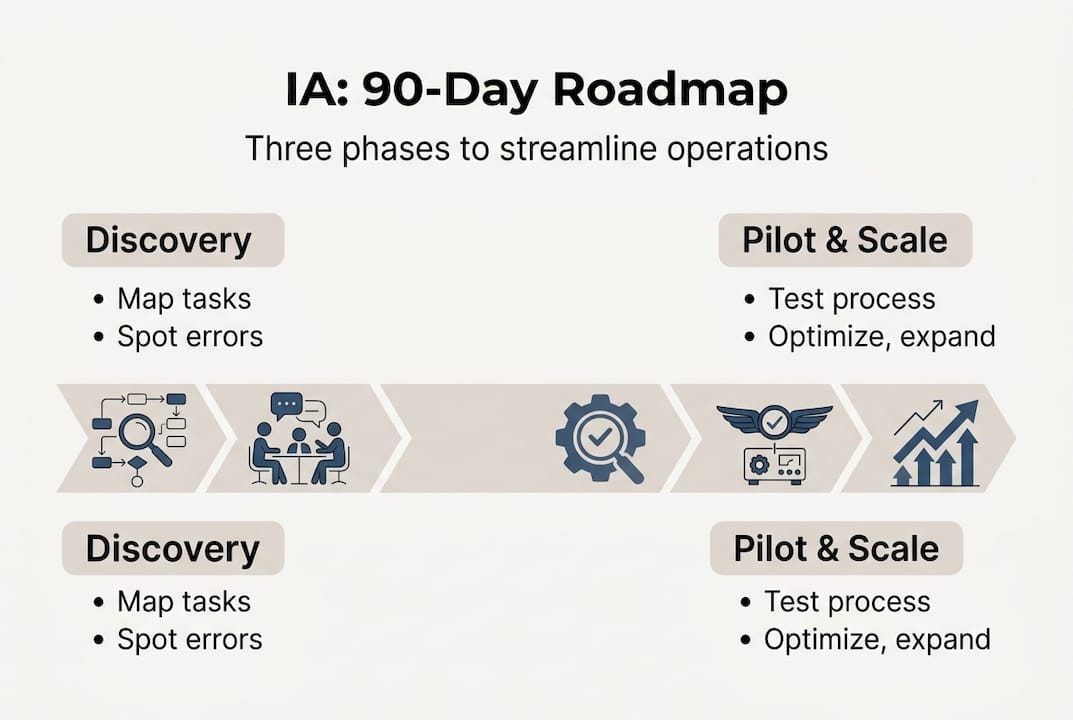
Phase 2: Pilot (Days 31 to 60) Select one or two processes and deploy a targeted solution using no-code or low-code platforms. Measure baseline metrics before launch, then track time saved, error rates, and staff feedback weekly.
Phase 3: Optimize and scale (Days 61 to 90) Refine the pilot based on real data. Integrate with your existing CRM or ERP. Expand to adjacent processes using the lessons learned.
Implementation methodologies for SMBs consistently recommend assessing high-volume repetitive tasks first, using phased rollouts, and measuring ROI through time saved and error reduction rather than abstract efficiency scores.
Common pitfalls to avoid during implementation:
- Overhyping internal expectations: Set realistic timelines and communicate them clearly to avoid disappointment.
- Ignoring legacy integration: Older systems often require middleware or API layers to connect with modern IA platforms.
- Skipping process redesign: Automating a broken process just produces broken results faster.
Pro Tip: Involve your team from day one. Staff who understand how IA augments their role, rather than replaces it, become advocates rather than resistors. Early buy-in accelerates adoption and surfaces practical insights that improve the deployment.
For businesses building customer-facing applications, AI-powered support and intent recognition capabilities are critical layers to integrate early. The SMB automation consulting playbook offers additional frameworks for scoping and sequencing your rollout.
What to watch for: Risks, limits, and expert insights
Intelligent automation is powerful, but it is not perfect. Forrester’s analysis is direct: IA fails on unstructured or novel data without fine-tuning, probabilistic errors require human-in-the-loop oversight, and legacy integration issues remain a persistent challenge. Context window limits affect large language models in document-heavy workflows.
“Intelligent automation excels in augmentation over full replacement. The human-in-the-loop model is not a workaround; it is the design.”
Additional risks worth monitoring include skill atrophy when staff stop practicing tasks fully handed to automation, ROI hype that inflates expectations beyond what a given process can deliver, and the temptation to automate before redesigning the underlying process. Reviewing process automation case studies reveals how agencies navigate these trade-offs in practice. For document-heavy workflows, LLM automation limitations are worth understanding before committing to a vendor.
A fresh perspective: The real opportunity (and trap) in intelligent automation for SMBs
Most IA conversations focus on cost reduction. That framing misses the deeper opportunity and sets businesses up for disappointment. The SMBs generating the most durable value from intelligent automation are not the ones that cut the most headcount. They are the ones that freed their best people to do work that actually requires human judgment.
Here is the uncomfortable truth: automation without process redesign is just faster chaos. If your invoicing process is disorganized, automating it produces disorganized invoices at scale. The technology does not fix bad workflows; it amplifies whatever is already there.
The contrarian takeaway for SMB leaders is this: true ROI from intelligent automation comes from smarter design, not just cheaper execution. Businesses that invest time in mapping, redesigning, and then automating their processes consistently outperform those that bolt IA onto existing chaos. Employee buy-in is not a soft concern. It is a hard performance variable. Teams that understand and shape the automation around them catch errors, suggest improvements, and drive continuous optimization. That human layer is what separates a system that works from one that merely runs.
Put intelligent automation to work for your business
Intelligent automation delivers measurable gains: fewer manual hours, lower error rates, faster customer response, and stronger margins. The path from insight to implementation does not have to be complicated, but it does benefit from expert guidance.
At SimplyAI, we design and implement practical IA solutions tailored to SMBs. Whether you need AI automation services to streamline your core workflows, AI agents for business to handle complex multi-step processes, or AI corporate education to bring your team up to speed, we build solutions that deliver results you can measure. The opportunity is real. The technology is ready. The next step is yours.
Frequently asked questions
What is intelligent automation in simple terms?
Intelligent automation combines AI and automation to handle business tasks that require learning, decision-making, and adaptation with little human intervention. Unlike basic scripts, it adapts to changing data and improves over time.
How is intelligent automation different from RPA?
RPA automates rule-based, repetitive tasks, while intelligent automation adds AI for handling judgment, unstructured data, and continuous adaptation. RPA executes structured tasks, while IA reasons through ambiguous ones.
What are quick-win use cases for SMBs with intelligent automation?
Top use cases include customer service automation, lead routing, and automated invoicing for fast ROI and improved efficiency. High-volume, low-complexity tasks deliver the fastest payback periods, often within 3 to 10 weeks.
What are the common challenges of intelligent automation?
Challenges include handling unstructured data, integration with legacy systems, potential errors, and the need for strong human oversight. Probabilistic errors and novel data require human-in-the-loop design to mitigate effectively.